
Fix the Exceptions First
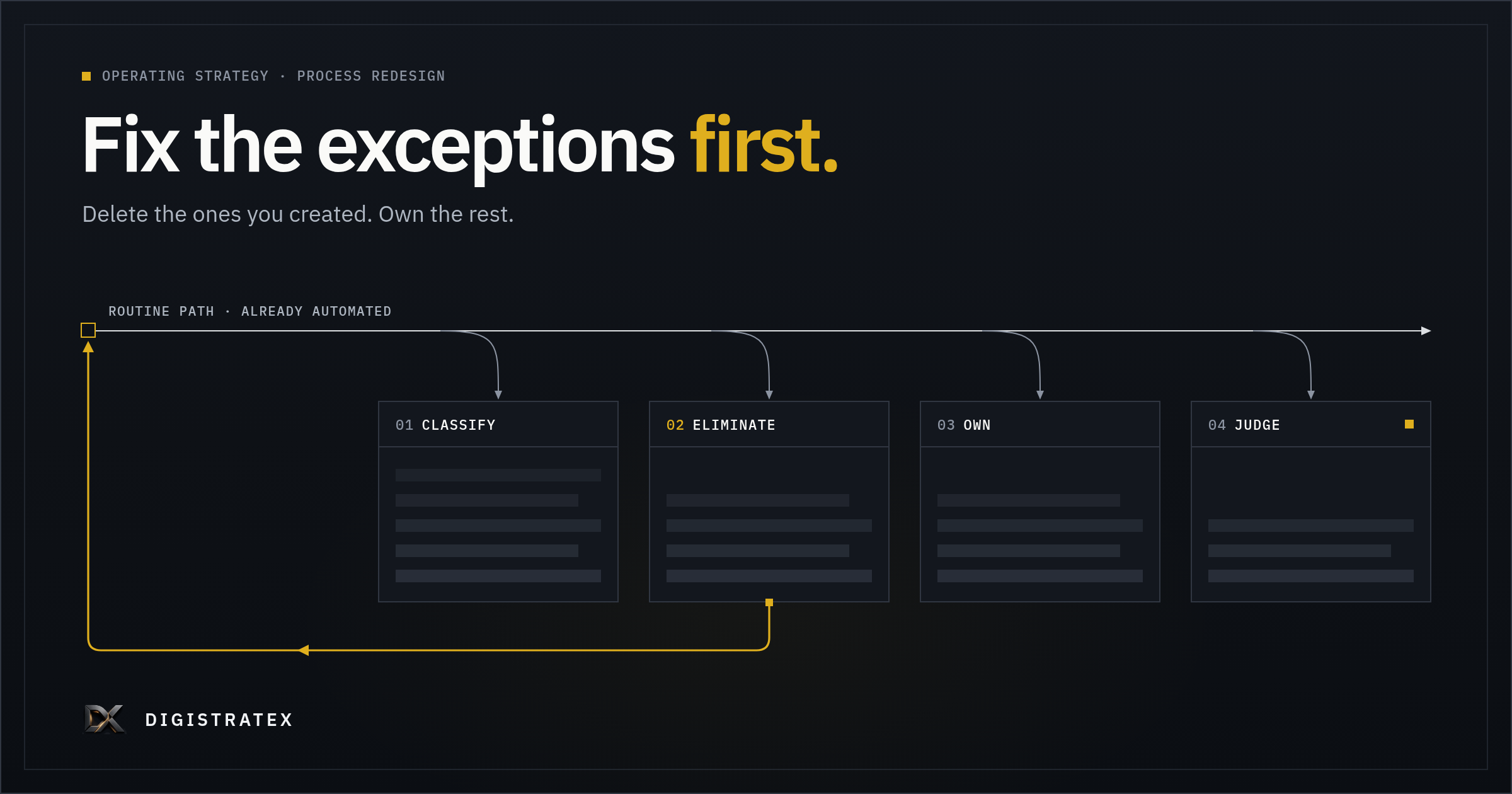
Most automation programs are aimed at the wrong work.
They start with the routine path: the clean application, the matched invoice, the claim with every field filled in. That path is easy to describe, easy to demo, and easy to automate. It was also already the cheapest work in the building.
The cost sits elsewhere. It sits in the cases that fall out of the routine path. They wait, bounce between teams, and come back a second time. Customers complain about them, auditors find them, and supervisors spend their week on them.
A common formula says AI should handle the routine and people should handle the exceptions. We have used that line ourselves. It is incomplete. It treats exceptions as leftovers. In most operations, exceptions are where the cost, the delay, and the customer pain are concentrated, and many of them should not exist at all.
So the order matters. Fix the exceptions first.
Two kinds of exceptions
Some exceptions come from the world. A customer's situation is unusual. Two rules genuinely conflict. A fact is disputed. These need judgment, and they always will.
Others come from inside the organization. An intake form allowed a submission without the document every reviewer needs. Two systems hold different addresses for the same supplier. A policy is written so loosely that two reviewers read it two ways. A rule added years ago still fires, though nobody remembers why.
The second kind is self-inflicted. The systems thinker John Seddon called the customer-facing version of it failure demand: "demand caused by a failure to do something or do something right for the customer." The same logic applies inside the back office. When you automate a self-inflicted exception, you have built a faster way to keep making it.
Step 1: Classify by cause, not by queue
Most organizations code exceptions by where they went: "sent to review," "pended," "returned." That describes workload. It says nothing about what to fix.
Public data shows how common this is. In KFF's analysis of federal transparency data for HealthCare.gov plans, insurers denied 20% of in-network claims in 2023, and the most common reason they reported was "Other," at 34%. Administrative reasons came next at 21%. Denial rates ranged from 1% to 54% by insurer. A spread that wide deserves investigation, and a top cause of "Other" means nobody outside the plan can tell which of those exceptions anyone should have prevented.
Government shows the stakes at a larger scale. Federal agencies estimated about $186 billion in improper payments across 64 programs in fiscal 2025. In its summary of that report, GAO notes that about 73% sat in five program areas and ties part of the year's increase to Medicaid eligibility redeterminations and provider screening. Its conclusion fits any operation: "Understanding the causes of improper payments is key to preventing them."
A usable cause code names something fixable and someone who can fix it: missing document at intake, reference data mismatch, ambiguous policy language, partner submission error, genuine judgment required. Our working rule, an assumption rather than a benchmark: if "other" or "unknown" holds more than a small single-digit share of volume, the taxonomy is not finished.
Step 2: Delete at the source before you automate anything
Every exception class you created has a point of origin, and the fix belongs there, not in the queue where the symptom lands.
Some illustrations, not client cases:
- Procurement. Invoices fail matching because purchase orders are raised after the invoice arrives. The fix is an ordering policy, not a smarter matching engine.
- Permitting. Applications come back for a missing site plan. The fix is an intake form that will not submit without one and says plainly what a complete plan includes.
- Claims. Claims pend because the provider address on the claim does not match the directory. The fix is one governed source of provider data.
The economics are simple. An exception removed at the source is paid for once. An exception automated is paid for on every transaction, in compute, in human review of the output, and in the customer's wait. We made a version of this point as one budget gate in The 38% Realization Gap. Here it is the first piece of operating work, done class by class.
Step 3: Give every surviving exception class an owner, a decision right, and a clock
What remains after Step 2 is real work. In most organizations, genuine exceptions live in a shared queue. The owner is whoever picks the case up. The decision right is "escalate." The service level is undefined because nobody measures the case from the customer's side.
Run each surviving class as a product line instead:
- One accountable owner for the volume, cost, and outcome of the class, not just the queue.
- A decision right at the lowest level that has the facts, with an explicit threshold in dollars, risk, or clinical or legal consequence above which it moves up.
- A service level measured from the customer's first contact to resolution, not from when a team touched it.
- A review date. Each quarter, ask whether the class is still genuine or whether it has become something the organization now creates and should eliminate.
Step 4: Apply AI where judgment is needed, and price its errors first
Now AI has the right job. It can assemble the facts from several systems, propose a resolution, and draft an explanation the customer can understand.
But judgment work fails in two directions. A wrong yes and a wrong no rarely cost the same. Paying an invoice that should have been held is a different loss from holding one that should have been paid. Wrongly denying a benefit costs something different from wrongly approving it, in money, in harm, and in trust.
Before any model touches a class, write down the cost of each error, decide which one the organization can least afford, and set confidence thresholds and human review around that choice. We argued in Five Decisions for a written authority envelope that sets what a system may execute. This is the companion question: for each class of judgment, which mistake are we choosing to risk? If no one can answer, the class is not ready for AI.
The Exception Redesign Scorecard
| Step | Baseline to Capture | Accountable Owner | Quality Guardrail | Validation Method |
|---|---|---|---|---|
| 1. Classify by cause | Exception volume and cost per case by class; share coded "other" or "unknown" | Process owner + operations analytics lead | Cause codes name a fixable source and an owner who can fix it | Sample audit: two reviewers code the same cases and agree |
| 2. Eliminate at source | Volume of each self-inflicted class before the upstream fix | Owner of the originating step (intake, data, policy, partner management) | Fix does not shift work to customers, partners, or another team | Class volume falls at the source and does not reappear under a new code |
| 3. Own, decide, and clock | Customer-measured time to resolution; handoffs and escalations per case | Named exception-class owner | Escalation thresholds written down; no class without an owner | Service level met; quarterly review confirms each class is still genuine |
| 4. Apply AI to judgment | Current error rate in each direction (wrong yes, wrong no) and cost of each | Business executive who owns the class + risk or legal lead | Error-cost asymmetry documented before launch; human review set to it | Error rates in both directions hold or improve against baseline after launch |
The Question for the Board
Map the Real Work showed how to see where work actually goes. This is what to do with what you find. The money is in the exceptions, and some of them are your own doing.
So before the next automation or AI program comes for approval, ask:
Which of the exceptions we are about to automate did we create ourselves, and why are we paying to make them faster instead of making them disappear?
If the team cannot separate the exceptions the world creates from the ones the organization creates, the program is not ready for approval.