
The 6% Problem: Five Decisions That Turn AI Into Operating Performance
Most leadership teams now have an AI program. Very few have an AI strategy.
The program is easy to spot across industries. There is an inventory of twenty or thirty departmental pilots, a steering committee chaired by technology rather than business-unit owners, a steady parade of vendor demos, and a board slide tracking "use cases in flight." Employees genuinely like the drafting and search tools on their desktops. Yet when the CEO and CFO look at unit cost, cycle time, customer retention, or operating margin, the income statement barely moves.
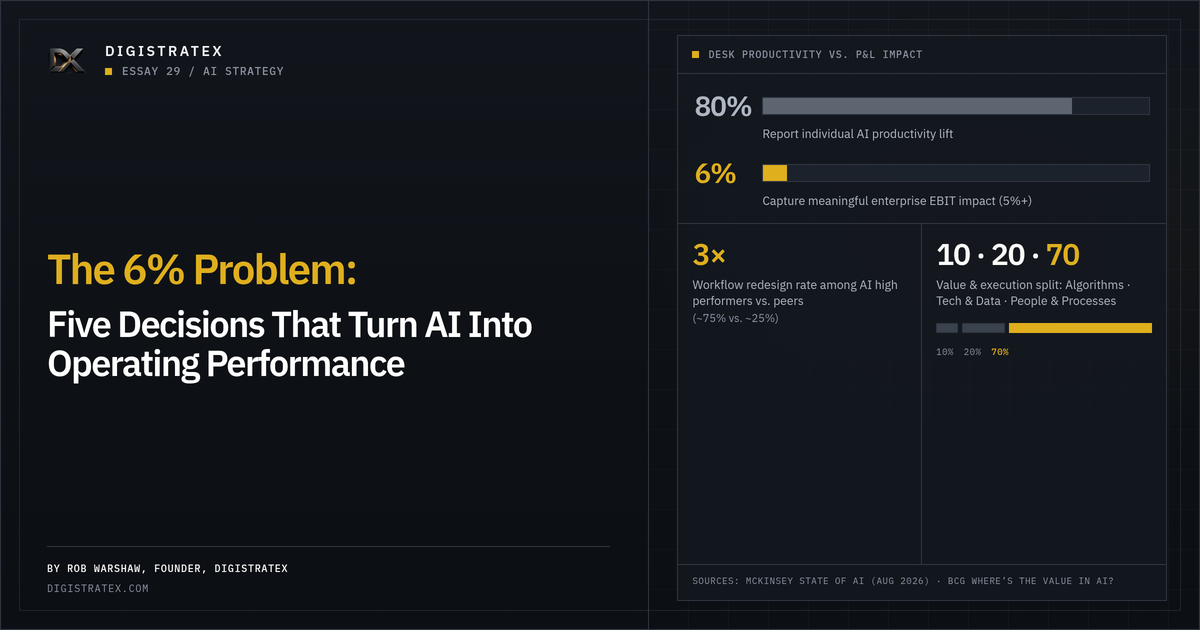
Empirical data now shows how wide that gap has grown. In McKinsey’s August 2026 State of AI survey of 1,719 participants across 97 countries, 80% say AI has improved their own individual productivity—yet only 37% attribute any enterprise EBIT impact to AI, virtually unchanged from 2025. The share of high performers attributing 5% or more of EBIT to AI remains flat at roughly 6%.
Productivity is showing up at the desk. It is not showing up in the business. Closing that gap is not a model-selection problem that can be delegated down the org chart. It comes down to five strategic decisions that only the CEO and executive team can make together.
1. Concentrate on three to five P&L-moving workflows—and sunset pilot sprawl
In early technology waves, letting every function run small experiments feels prudent. In enterprise AI, breadth usually starves the initiatives that actually matter.
In Boston Consulting Group’s Where’s the Value in AI? study of 1,000 CxOs and senior executives across 59 countries, companies generating real value pursued roughly half as many AI opportunities as their peers—and expected more than twice the ROI. BCG also found that 62% of AI value sits inside core business operations rather than corporate support functions.
When a company spreads engineering talent, data remediation, and leadership attention across thirty disconnected pilots, each project gets enough funding to build a prototype and none gets enough to re-architect an end-to-end production workflow. Nobody rebuilds claims adjudication, quote-to-cash, clinical intake, commercial pricing, or customer fulfillment on one-thirtieth of a transformation budget.
The CEO’s first job is portfolio discipline: name the three to five core workflows where a step-change in unit cost, cycle time, accuracy, or revenue retention materially moves enterprise value, fund those to production completion, and shut down pilots that have no line of sight to a P&L owner.
2. Redesign the work and decision rights before automating them
Putting a frontier model on top of a fragmented process does not fix the process. It simply moves exceptions faster between the same bottlenecks.
McKinsey’s 2026 survey captures the dividing line clearly: nearly three-quarters of AI high performers have fundamentally redesigned workflows around AI—up from 55% a year earlier—compared with roughly one-quarter of other companies. High performers are also twice as likely to have visible senior-leadership commitment and defined processes for measuring operational impact.
Real redesign forces operational questions a software vendor cannot answer for you. Which review layers exist only because assembling context across four legacy systems used to take forty minutes? Which exceptions genuinely require a specialist, and which ones belong at the point of first contact? When an AI system flags a billing discrepancy, an underwriting risk, or a service recovery issue, does a frontline operator now have the authority to resolve it on the spot—or does it still sit in a supervisor queue for three days?
In complex operations, the model is the catalyst, not the payoff. Collapsing handoffs, retiring redundant approval steps, and moving decision rights closer to the customer or transaction are what turn faster information into lower unit cost and better experience.
3. Treat operational data and business context as the moat—not the model
Foundation models are converging in capability and falling in unit price every quarter. Competitors can rent the same models you rent by Friday afternoon. What they cannot rent is your operational context: years of adjudicated exceptions, pricing realizations, supplier performance histories, service-call root causes, and real-time transaction state.
That data layer is also where most AI roadmaps quietly break down. In a February 2025 Gartner assessment of enterprise data readiness, 63% of organizations reported that they either lack or are unsure whether they have the right data management practices for AI—leading Gartner to predict that through 2026, organizations will abandon 60% of AI projects that are not supported by AI-ready data.
Data readiness fails when leadership treats it as an IT cleanup project rather than an operating responsibility. Every priority workflow needs a named business executive—not just a data architect—accountable for the definitions, ground-truth labels, quality thresholds, and live production feeds that workflow depends on. If denial reason codes, contract terms, or customer entitlements are inconsistent at the source, a more capable model will only scale the inconsistency with greater confidence.
4. Set explicit authority limits before AI touches customers, prices, or commitments
Many leadership teams still govern internal employee productivity tools and external decision-making agents through the same review checklist. Operationally and legally, they are different classes of risk.
An internal tool that drafts a briefing memo or summarizes a call transcript carries bounded downside because a human reads the output before acting. A production agent that modifies a quote, approves or pends a transaction, alters a schedule, or communicates policy terms directly to a customer is exercising delegated corporate authority.
As companies rush toward autonomous workflows, weak guardrails are becoming expensive. Gartner predicted in June 2025 that more than 40% of agentic AI projects will be canceled by the end of 2027 due to escalating costs, unclear business value, or inadequate risk controls—warning of widespread vendor "agent washing" in a market where only about 130 of thousands of self-described agentic vendors offer real agentic capabilities. Not surprisingly, McKinsey found that 2026 high performers are far more disciplined about mitigating unauthorized or unintended AI actions.
Before any system goes into production, leadership should sign off on a written authority envelope: what the system is permitted to execute autonomously, what dollar, clinical, or regulatory threshold triggers mandatory human escalation, how every automated action is logged for audit, and how quickly operations can throttle or halt the system if behavior drifts. If no executive on the leadership team is willing to own the system’s decisions on their personal scorecard, the system has no business making them.
5. Convert saved hours into operating leverage—across roles, scorecards, and vendor contracts
BCG’s 10-20-70 rule remains the sharpest allocation benchmark for leadership teams: roughly 10% of AI value creation comes from algorithms, 20% from the underlying technology and data backbone, and 70% from redesigning roles, skills, and business processes—where roughly 70% of implementation hurdles also occur.
The hardest truth for executive teams is that saved minutes do not automatically convert into financial results. If five hundred specialists each save six minutes an hour using an AI copilot, but staffing models, throughput targets, territories, and frontline incentives stay untouched, those saved minutes evaporate into organizational slack. McKinsey’s 2026 survey illustrates how often workforce assumptions diverge from execution: only 14% of respondents reported that AI reduced headcount at their organization over the past year, less than half the 32% who had predicted a reduction twelve months earlier.
Capturing operating leverage requires deciding before deployment where freed capacity goes. In a growth segment, it may mean expanding account coverage or shortening turnaround times to win share without adding fixed overhead. In a mature operation, it may mean absorbing volume growth, retiring outsourced overflow vendors, or managing planned attrition against tighter unit-cost targets. And at the procurement table, it means structuring vendor agreements around verified workflow outcomes rather than paying open-ended seat licenses or unthrottled consumption fees regardless of business results.
The CEO’s Five-Point AI Strategy Scorecard
| Strategic Decision | Accountable Owner | Failure Mode to Spot | Operating Proof Point |
|---|---|---|---|
| 1. Concentrate on 3–5 P&L workflows | CEO & CFO | 25+ scattered pilots; none funded through production | Majority of AI spend concentrated in top 3–5 named P&L workflows |
| 2. Redesign work & decision rights | COO & Business-Unit Heads | AI bolted onto unchanged queues and approval layers | End-to-end cycle-time compression; legacy handoffs and sign-offs retired |
| 3. Own operational data & context | Workflow Business Owner + CIO/CDO | "Data cleanup" deferred to Phase 2 or left solely to IT | Named business owner, live quality SLA, and audited ground truth per workflow |
| 4. Bound production authority | System Executive Owner + GC/CRO | Customer- or price-facing AI launched without escalation caps | Written authority envelope, 100% action auditability, and same-day kill switch |
| 5. Convert saved time into leverage | Business-Unit Head, CHRO & CFO | High tool usage on dashboards with flat unit cost and margin | Freed capacity explicitly booked into growth throughput, quality, or unit-cost plan |
The Question for Monday’s Leadership Meeting
The 6% of enterprises generating real operating profit from AI do not have secret models. They made harder leadership choices earlier than their peers: fewer priorities, redesigned workflows, business-owned data, explicit authority boundaries, and an operating plan that converts saved time into measurable performance.
Put one question on the table at your next executive staff meeting:
Which three workflows will AI measurably change on our operating statement over the next twelve months—and which executive at this table owns the redesign, the data, the risk boundary, and the P&L number for each one?
If answering that question takes more than five minutes, your company has an AI program. Your job as a leadership team is to turn it into a strategy.