
The 38% Realization Gap: How CEOs and Boards Should Underwrite 2027 AI Budgets
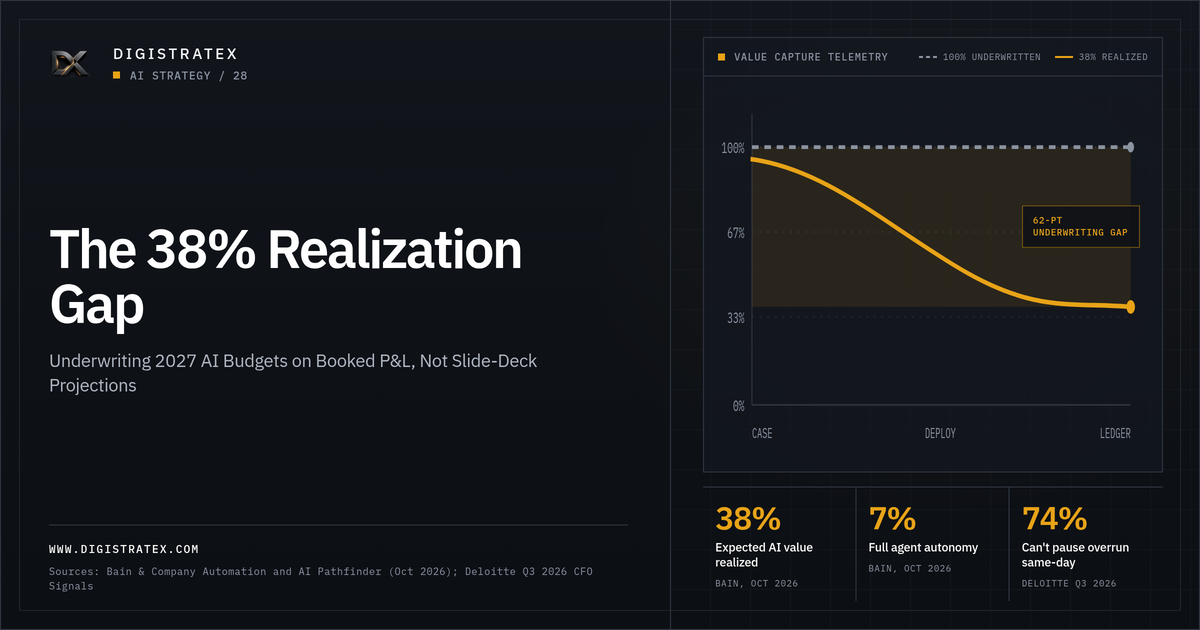
Across boardrooms this month, leadership teams are locking 2027 operating plans around an expensive contradiction.
Most enterprises plan to spend more on artificial intelligence next year, often funding those budgets by trimming general and administrative expense elsewhere on the income statement. Yet three independent datasets released over the past four weeks show that most organizations are capturing only a fraction of the returns they projected in 2026—and lack the financial circuit breakers to stop an AI cost overrun once a workflow goes live.
In Bain & Company’s October 2026 Automation and AI Pathfinder survey of 951 companies across 63 enterprise processes, organizations converted just 38% of generative AI’s expected value into deployed, measurable business results. Nearly 40% of companies that tracked AI cost savings landed below 10%, despite targeting 11% to 20%.
Meanwhile, a September survey of 400 global finance chiefs by RGP, reported November 3 by CFO.com found that only 10% of CFOs see significant positive ROI from AI today—and just 1% at companies under $1 billion in revenue—even as 54% tell their boards those returns will materialize within 24 months.
Then comes the control exposure. According to Deloitte’s third-quarter 2026 CFO Signals survey of 200 North American CFOs at billion-dollar-plus enterprises, 74% of organizations would need several business days to several weeks to pause or shut down an AI workload if spending exceeded approved limits. Only 19% could intervene on the same business day, and just 7% have automated, near-real-time controls.
Put those three numbers in the same board packet—38% value realization, 10% seeing significant ROI today, and 74% unable to halt a cost overrun the same day—and the 2027 budgeting risk comes into sharp focus. Too many companies are underwriting next year’s AI commitments with unbooked savings from last year’s business cases.
Why 2026 AI Business Cases Missed the General Ledger
The gap between AI activity and audited margin improvement rarely comes down to model quality. Over a ten-week stretch in mid-2026, as Bain’s researchers noted, the four largest AI providers committed more than $9 billion to embedding forward-deployed engineers inside enterprise customers—not because frontier models were too weak, but because enterprise workflows were not built to convert model capability into P&L results.
Three structural errors keep breaking the math between the investment memo and the general ledger.
First, investment cases assume full autonomy while operations run supervised. Bain found that only about 7% of companies run fully autonomous agents in production, yet business cases routinely price labor savings as if software will clear transactions end to end. In regulated environments such as health-plan benefit operations, utilization management, payment integrity, and revenue-cycle administration, keeping clinicians, claims examiners, or compliance reviewers in the loop is often the right clinical and legal decision. Approving a full-autonomy financial model while operating a human-supervised workflow, however, guarantees an unbudgeted variance.
Second, teams automate workflow debt instead of retiring it. Layering an agent onto broken handoffs, legacy edits, and multi-tier exception queues does not fix an obsolete operating model. It executes the same friction faster, hardens old rules into new prompts, and treats the bloated baseline as fixed. In a health plan or private-equity portfolio company, speeding up an avoidable pended claim or member inquiry still consumes compute and human review; redesigning upstream rules so the exception never triggers removes the cost altogether.
Third, AI unit economics behave like variable cost of goods, not flat seat licenses. For two decades, enterprise software meant predictable annual subscriptions where heavier employee usage improved unit economics. Token-metered models and consumption-priced agents invert that logic. Long context windows—such as feeding multi-hundred-page medical records, provider contracts, or diligence files into multi-step agent loops—can spike variable compute expense overnight. Yet Deloitte’s Q3 2026 survey found that 53% of finance teams still review AI spending retrospectively through monthly vendor invoices, 38% lack timely visibility into token usage and unit costs, and 80% rely on basic or legacy IT controls rather than workload-level gateways. Worse, 27% of CFOs already report contract friction from vendor metering and "tollgating" fees—new charges to extract or query operational data enterprises long treated as their own.
Accountability Cannot Sit in a Steering Committee
When RGP asked finance chiefs how major transformation initiatives are governed, only 13% reported running them with a single point of enterprise accountability. Nearly 80% of CFOs in Deloitte’s survey now play a formal role in approving AI investments, yet approval at the project gate means very little if nobody owns the net cost per transaction six months after launch.
In DigiStratEx’s advisory work with CEOs, CFOs, and private-equity leadership teams, the dividing line between stranded pilots and durable margin expansion is operating-model discipline. AI budgets should not be approved as annual lump sums based on theoretical hours saved. They should be released in tranches governed by realized general-ledger performance, explicit production-autonomy assumptions, and automated cost circuit breakers.
The 2027 AI Tranche & Circuit-Breaker Scorecard
Before signing off on 2027 AI capital and operating allocations, CEOs and boards should require every material AI workflow to clear five underwriting gates.
| Underwriting Gate | Baseline Required | Accountable Owner | Quality & Experience Guardrail | Validation Method |
|---|---|---|---|---|
| 1. Realization-Adjusted Tranche Funding | Audited 2026 booked savings vs. original investment case (net of integration, compute, and vendor fees) | CFO & Business-Unit P&L Leader | Zero backfill hiring or overtime creep in functions claiming AI capacity gains | General-ledger reconciliation; Wave 2 tranche discounted to Wave 1’s realized capture rate |
| 2. Supervised-Production Unit Economics | Current all-in cost per resolved claim, authorization, contract, or service event—including human review minutes | COO / Functional Operations SVP | Error, appeal-overturn, and rework rates must hold steady or improve vs. pre-AI baseline | Monthly variance tracking of actual human-in-the-loop touch rate vs. business-case assumption |
| 3. Workflow-Debt Retirement Prerequisite | End-to-end map of exception volume, handoffs, and legacy rules generating the workload today | Enterprise Transformation / Process Owner | Member, patient, or customer cycle time and first-contact resolution improve measurably | Documented retirement of redundant steps and upstream defect sources prior to agent build |
| 4. Same-Day Cost & Authority Circuit Breakers | Token consumption, context-window size, and maximum dollar/action authority per agent transaction | CIO / Chief AI Architect & Controller | Automated fallback to standard queue with zero dropped member or customer requests | Live AI gateway test proving runaway token loops or unauthorized actions halt within 4 hours |
| 5. Anti-Tollgating Contract Hygiene | Total cost of ownership across model tokens, orchestration, data retrieval, and egress at 3× volume | General Counsel & VP of Strategic Sourcing | Unrestricted portability of company records, prompts, and audit logs across model providers | Executed contract terms barring data-egress tollgates and capping per-unit metering escalators |
How Leadership Teams Put the Scorecard to Work
Running these five gates changes the 2027 budget conversation immediately.
First, stop letting unverified 2026 "productivity" fund 2027 SG&A cuts. If last year’s automation cohort delivered a 40% realization rate on projected savings, underwrite next year’s tranche at 40% until operational leadership proves higher capture in the general ledger. Honest math shrinks slide-deck heroics and prevents mid-year margin surprises.
Second, separate model experimentation from production authority. Experimentation belongs in a small, capped sandbox budget. Any agent moving into core operations—adjudicating a claim edit, triaging clinical documentation, repricing a renewal, or issuing a customer credit—must carry a bounded authority limit, workload-level token attribution, and an automated circuit breaker that throttles spend in hours rather than weeks.
Third, treat vendor outcome alignment as a procurement requirement. As Salesforce’s shift to consumption-based agentic work units and ServiceNow’s real-time AI Control Tower illustrate, enterprise software vendors already know buyers are moving from seat counts to documented execution. Leadership teams have real leverage right now to demand native unit-cost telemetry and reject data-access tollgates before signing multi-year renewals.
The Question for the 2027 Budget Room
RGP’s analysts offered a blunt warning alongside their November survey: the 24-month AI payoff promise is now on the record, and boards will hold executive teams to it. By late 2027, explaining that adoption rose while unit costs stayed flat will not survive a board audit.
Before approving next year’s AI spend, every CEO and board director should ask one question of the executive presenting the plan:
How much of next year’s budget is funded by savings that have already hit the general ledger—and if this workflow’s token costs double on a Tuesday morning, who gets alerted and how many hours does it take to shut it off?