
Map the Real Work Before You Redesign It
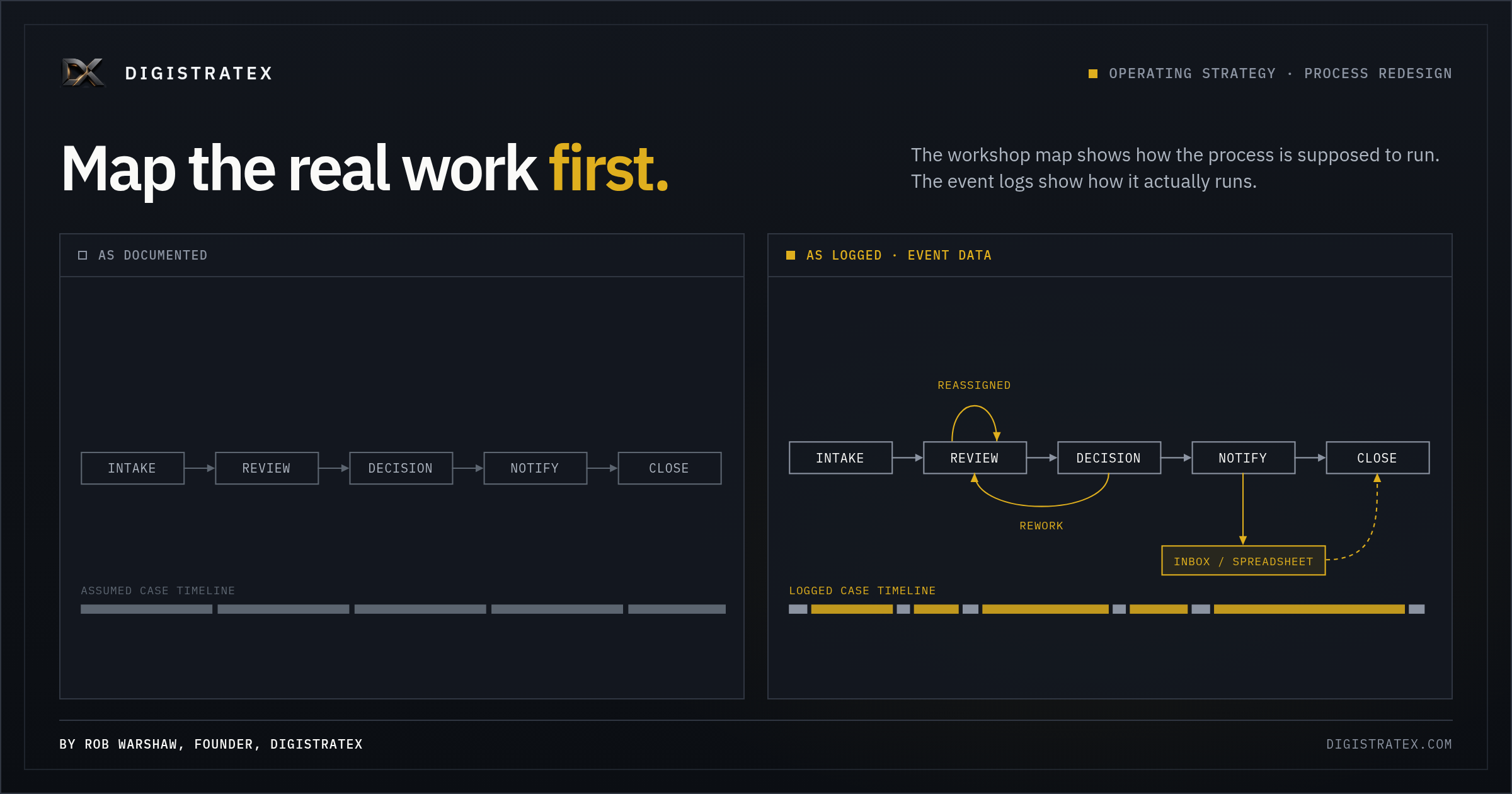
Every redesign starts with a picture of the work. Most of those pictures are wrong.
They usually come from a workshop. A dozen people in a room, sticky notes on a wall, a facilitator asking what happens next. The answer describes how the process is supposed to run, filtered through whoever was senior enough to be invited. The SOP binder says the same thing. The org chart says who owns each box.
Meanwhile, the systems that run the work have been keeping a different record. Every claim, order, ticket, permit application, and service request leaves a trail of timestamps as it moves: created, assigned, pended, reassigned, reopened, closed. That trail is the process as it actually runs. In most organizations it sits unused.
Here is the tension. Leadership teams spend months debating the future state and almost no time verifying the current one. A redesign built on the imagined process will solve the imagined problems.
The documented process and the real one are different processes
The gap is not a documentation failure. It is what happens to any process that runs at volume for years.
People build workarounds when a system cannot do what the work needs. Exceptions grow their own side channels: a shared inbox, a spreadsheet, a supervisor who "just knows." Rules change and the SOP does not. A step added after one audit finding becomes permanent.
None of this shows up on the workshop wall. The people in the room either do not see it or have done it so long it no longer looks like a workaround.
In my years inside healthcare operations, the most expensive work rarely sat in the documented flow. It sat in the pends, the reroutes, and the "send it back to intake" loops that nobody had drawn.
Start with three fields you already have
You do not need a new platform to begin. You need three fields from systems you already run: a case identifier, an activity name, and a timestamp. That event data is the foundation of process mining, a discipline the IEEE Task Force on Process Mining describes as a tool to improve the design, control, and support of operational processes.
Where to pull it:
- Core transaction systems. ERP for order-to-cash and procure-to-pay, CRM, claims, case management, permitting. Status-change and audit tables are the most valuable.
- Ticketing and queue tools. Creation, assignment, reassignment, resolution, reopen.
- Email and shared-inbox metadata. When a request arrived and when it was answered. Metadata, not message contents.
- Contact center records. Transfers, callbacks, repeat contacts.
- Ownership history. Every change of owner, team, or queue. This is your handoff data.
Public data shows how ordinary this is. New York City publishes its 311 service requests as open data, and each record carries a created date, a closed date, and the responsible agency. A city that wants to know how long a noise complaint or pothole really takes does not need a workshop. It needs a query.
Health plans are being pushed the same way. Under the CMS Interoperability and Prior Authorization final rule (CMS-0057-F), most impacted payers must send prior authorization decisions within 72 hours for expedited requests and seven calendar days for standard ones, and must publicly report prior authorization metrics every year. The first set was due March 31, 2026. A plan that cannot reconstruct each request's real path from submission to decision will struggle to explain its own numbers.
Build the as-is map in weeks, not quarters
The sequence we use is deliberately short.
Weeks 1–2: Scope one flow. Define its start and end in customer terms: application received to permit issued, order placed to cash collected, claim received to paid or denied. Name one business owner. Pull three to six months of event data.
Weeks 3–4: Stitch the case. Follow the same case across systems. Expect identifiers that do not match. That mismatch is itself a finding, because it marks where handoffs lose context.
Weeks 5–6: Draw and test the map. Process-mining software will draw it. For a first pass, a capable analyst with SQL can measure most of what matters. Then take the map to the people who do the work, not to defend it but to explain it. The data shows what happened. The frontline explains why.
Six weeks is a planning assumption, not a benchmark. Data access, not analysis, is usually what sets the pace.
What to look for
- Variants. The documented process has one path. Count how many the cases actually take, and what share of volume follows the intended one.
- Wait time versus touch time. Compare the time a case sits between steps with the time someone works on it. Where waiting dominates, automating the work steps will not move cycle time.
- Rework loops. Any activity that repeats on the same case: reopened tickets, resubmitted applications, claims pended and released more than once.
- Handoffs. Count changes of owner per case. Every handoff is a queue and a chance to lose context.
- Off-system paths. Gaps in the timestamps where work left for email or a spreadsheet and came back later.
Take order-to-cash. If the log shows a loop of invoice issued, dispute logged, credit memo, and re-invoice on a meaningful share of orders, the redesign target is not collections. It is whatever upstream step produces the wrong invoice. A workshop organized around the collections team would rarely find that.
Map the work, not the worker
System event logs describe how cases move. Task mining is different. It records activity on employee desktops to capture the work that happens between systems. It can answer questions the logs cannot, and handled carelessly it can damage your relationship with the workforce.
The guardrails we hold to:
- Logs first. Use desktop capture only for specific questions the system data cannot answer.
- Notice before capture. Tell people in writing what is collected, why, for how long, and what it will not be used for. Connecticut has long required employers to give prior written notice of electronic monitoring on their premises (§31-48d), and Public Act 26-73 tightened it as of October 1, 2026, including a plain-language written statement for new hires. Those rules may not reach every form of task mining, particularly of remote staff, and other states set their own, so bring counsel in early.
- Aggregate. The unit of analysis is the case and the step, never the individual.
- No performance use. Put in writing that mapping data will not feed individual reviews.
- Minimum necessary. Mask patient, customer, and case content. Keep timestamps and activity codes.
- A deletion date. Set it at the start.
If employees believe the map is surveillance, they will route the real work around it, and you will be mapping fiction again. We have written about why privacy can accelerate enterprise AI. The same logic applies here.
The Real-Work Map Checklist
| Question | Data Source | Accountable Owner | What Good Looks Like |
|---|---|---|---|
| Where does the flow really start and end? | First and last events in the system of record | Business process owner | Start and end defined in customer terms and agreed by every function the flow touches |
| How many paths do cases take? | Event-log variants | Process owner + analytics lead | Variants counted; share of volume on the intended path known |
| Where does the time go? | Timestamps between activities | COO or operations lead | Wait time and touch time measured for each step |
| Where does work repeat? | Repeated activities per case ID | Operations and quality lead | Rework rate for each loop, with a named root cause |
| How many handoffs? | Owner and queue change history | Process owner | Handoffs per case counted, each one justified |
| Where does work leave the system? | Timestamp gaps, inbox metadata, frontline interviews | Operations + CIO | Off-system channels listed with volumes |
| Are we mapping work, not workers? | Monitoring notice, data-use policy | CHRO + General Counsel | Written notice, aggregation, no performance use, deletion date |
The Question for the Board
We have argued before that the work has to be redesigned before it is automated, in Five Decisions That Turn AI Into Operating Performance. This is the step before that one. You cannot redesign work you have not seen.
So before the next redesign or AI program reaches the board for approval, ask one question:
Is the process map in front of us drawn from our own systems, or from how we believe the work runs?
If the team cannot show the variants, the waits, the loops, and the handoffs from the data, the redesign is not ready for approval. It is a theory. The systems already know the answer.