
Check Before You Ask
Most services start with a form. Many of those forms ask people to prove things the organization could check for itself.
That is a design choice, and it has a cost. Every question moves verification work from the agency to the person. The people least able to do that work are often the ones the service exists for. When they cannot finish it, they drop out. They are still eligible. They just never got through.
So redesign the order. Check the data you hold first. Ask only for what is missing.
The form is a design choice
Medicaid renewals are the clearest public record of this choice. When pandemic-era continuous coverage ended, states had to redetermine eligibility for everyone. KFF's unwinding tracker counts over 25 million people disenrolled. Nearly seven in ten of them, 69%, lost coverage "for paperwork or procedural reasons." Only 31% were found ineligible. KFF notes that many of the people disenrolled for paperwork reasons "may still be eligible."
The rule already said check first. Federal regulation requires the agency to renew eligibility "without requiring information from the individual" when reliable data it holds or can access is enough. Only if that fails does the person get a renewal form, and it is supposed to come pre-filled.
States followed the same rule and got very different results. Across the unwinding, 61% of renewals were completed automatically, with no action from the person. By state, that share ran from 90% or more in Arizona, North Carolina, and Rhode Island to less than 20% in Pennsylvania and Texas.
Same rule, and a more than fourfold gap. KFF points to a mix of causes behind the spread in state outcomes, including "differences in renewal policies and system capacity." Both are choices a state makes.
Medicaid is not unusual. It is simply well measured. The federal government's own inventory of approved information collections puts the public's burden at about 11.4 billion hours a year as of November 2026. That is federal forms alone.
Decide person by person
The unwinding also showed how an automated path can fail.
In August 2023, CMS asked every state to check for a specific systems issue. Thirty states had it, and nearly 500,000 children and other individuals who had been improperly disenrolled were set to regain coverage. They had been removed "even when the state had information indicating the person remained eligible."
The cause was a design rule. As KFF explained, if those systems could not renew everyone in a household automatically, they sent forms to the whole family and disenrolled everyone when the forms did not come back. That happened "even if the states had information to renew coverage for some family members, most often children."
The lesson goes well beyond Medicaid. When automation works at the level of the bundle, whether that is a household, an account, or a multi-line order, one unverifiable item pushes everything back to paper. Decide each person, each line, and each item on its own. Then ask only about the part you could not confirm.
The next test is due January 1
States are about to add more questions. Under the 2025 reconciliation law, Medicaid eligibility for adults in the expansion group will depend on work requirements, checked at application and at least every six months, due to start January 1, 2027, though HHS can exempt states making a good-faith effort through the end of 2028.
The same check-first logic applies. KFF's survey of states reports that states "are required to use available data from reliable sources to 'data match'" for compliance or exemption. Six states plan to use AI, and five of them want it for processing documents and improving data matching.
That is the right job for AI here: reading the documents people do send, matching records across sources, and pre-filling what is known. The work sits behind the front door, not in it. But one warning deserves a place in every vendor review. KFF reports that in its focus groups, one state made the point that the tools vendors are pitching "are unlikely to be able to provide data to verify the status of individuals the states expect to have the most challenges with, such as gig workers, medically frail individuals, and individuals experiencing homelessness."
Automation will clear the easy cases. The design question is what happens to everyone else.
Redesign the ask
The same pattern runs well beyond benefits. Some illustrations, not client cases:
- Permits. A town renewal form asks contractors for a license number the state licensing board already publishes.
- Commercial insurance. A renewal questionnaire asks a client to re-enter facts already in last year's file.
- Banking. A periodic customer review asks for documents the bank received last year and has not seen change.
The redesign works the same way in each case:
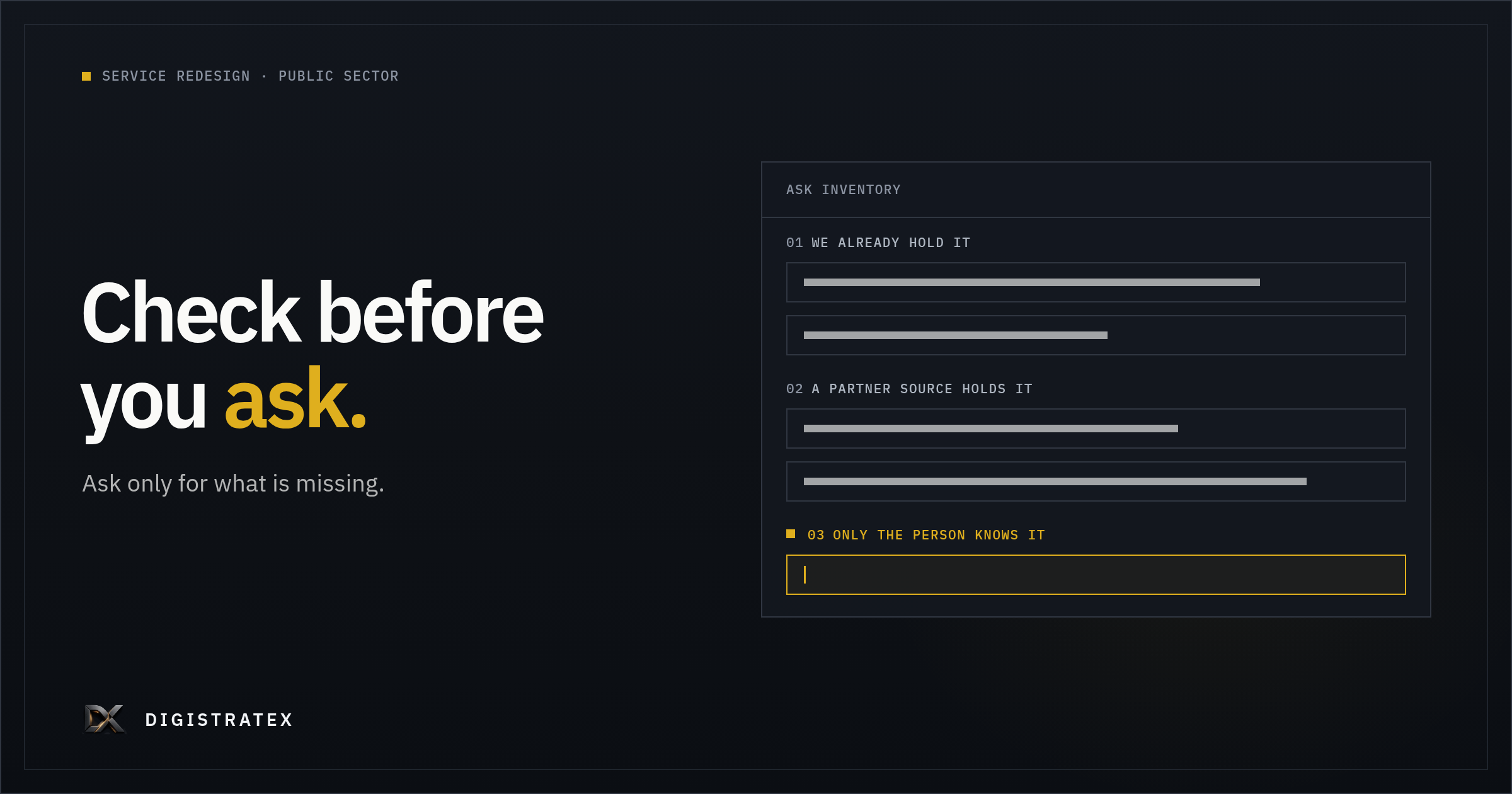
- Inventory every question. Tag each one: we already hold it, a partner source holds it, or only the person knows it. Questions in the first two groups should not reach the person.
- Check before you ask. Run the data match first, and complete the decision when the data is enough. Tell the person what you decided and on what basis, and give them an easy way to correct it.
- Pre-fill what remains. When a form has to go out, it should show what you know and ask only about the gap.
- Decide person by person. Never let one unverified member, line, or item send a whole household, account, or order back to manual review.
- Measure who you lose. Count exits for procedural reasons separately from people found ineligible, and count how many come back. A working rule, not a benchmark: treat a procedural exit who returns within 90 days, the federal reconsideration window, as a process failure, not a choice the person made.
The economics follow. A hypothetical for illustration: if a program renews 100,000 people a year, each point of automated completion is 1,000 fewer forms mailed, chased, keyed, and reviewed. It is also 1,000 fewer chances to lose someone who qualifies.
Fixing the internal causes of rework, as we argued in Fix the Exceptions First, makes the work cleaner. This step goes further. It removes the question altogether. To find where your questions stall, measure the path from data rather than from a workshop, as we described in Map the Real Work Before You Redesign It.
The Check-Before-You-Ask Scorecard
| Measure | Baseline to Capture | Accountable Owner | Quality Guardrail | Validation Method |
|---|---|---|---|---|
| 1. Ask inventory | Every question on the form, tagged held / partner-held / only the person knows | Program or service owner | No question asks for data already held without a written reason | Quarterly review of the form against available data sources |
| 2. Automated completion | Share of decisions completed from data with no action by the person | Operations lead + CIO | Every automated decision is sent to the person with its basis and an easy way to correct it | Sample audit of automated decisions against source records |
| 3. Person-level decisions | Share of cases where one unverified member or item sends the whole case to manual review | CIO + eligibility or underwriting lead | Decisions made per person, line, or item | Test cases with mixed households or accounts before each release |
| 4. Procedural loss | Exits for paperwork reasons as a share of all exits | Agency director or COO | Reported separately from people found ineligible | Monthly report; trend by channel and population |
| 5. Return within 90 days | People who exit for paperwork reasons and come back within 90 days | Program owner + finance | Treated as a process failure, with a named cause | Match exits to re-entries by person |
| 6. Hard-case coverage | Volume of cases the data cannot verify (gig work, unstable housing, frailty) | Program owner + legal or policy lead | A named human path with a service level, not a default denial | Outcomes for these groups tracked against everyone else |
The Question for the Board
Leadership teams review how fast forms get processed. They rarely review whether the forms should exist.
So at the next service or operations review, ask:
Of the people who left our program last year for paperwork reasons, how many did we already have the data to keep?
If no one can answer, the service is still asking first.