
Buy What You Can Leave
Every leadership team eventually gets the same slide. Build, buy, or partner.
The evidence says buy more often than you think. The instinct in the room says build, because nobody wants to be locked in. Both sides are arguing about the entry. The decision is settled by the exit.
So start there. Decide what you must own, buy what you can leave, and price the leaving before you sign anything.
The evidence favors buying, with a catch
MIT's Project NANDA interviewed 52 organizations for its 2025 report on enterprise AI. In that sample, external partnerships with customized tools reached deployment about 67% of the time, compared with about 33% for internally built tools. The authors are careful: the figures are self-reported, and the gap may reflect the organizations that chose to buy rather than the act of buying.
Still, the direction is hard to ignore. Building every layer yourself is slow, and most of what it produces is not what makes you different.
The catch is what a successful purchase quietly moves outside the building. The vendor learns your exceptions. Its configuration holds your rules. Its team knows why the system behaves the way it does. After three years, the tool works, and nobody inside can explain it without calling the account manager.
That is lock-in. It does not show up on the invoice.
The exit fee is disappearing. The exit cost is not.
Regulators are already removing the visible part of switching. Under the EU Data Act, from January 12, 2027, cloud and data processing providers may not charge customers switching fees, and, as a general rule, must complete the switch within a 30-calendar-day transitional period.
That is useful. It also shows how small the fee always was.
When an organization tries to leave a provider, the expensive part is rarely the transfer charge. It is everything the organization never kept for itself:
- The decision rules, written only as settings inside someone else's product.
- The history of cases and how each was resolved, stored in a format only the old system reads.
- Any way to prove the replacement works as well as what it replaces.
- People who understand the work well enough to run it during the switch.
None of that is covered by a portability clause on records and logs, which we argued for as one budget gate in The 38% Realization Gap. Data you can export is necessary. It is not the same as knowledge you can use.
Decide by layer, not by product
"Build, buy, or partner" treats a system as one thing. It is at least five, and they deserve different answers.
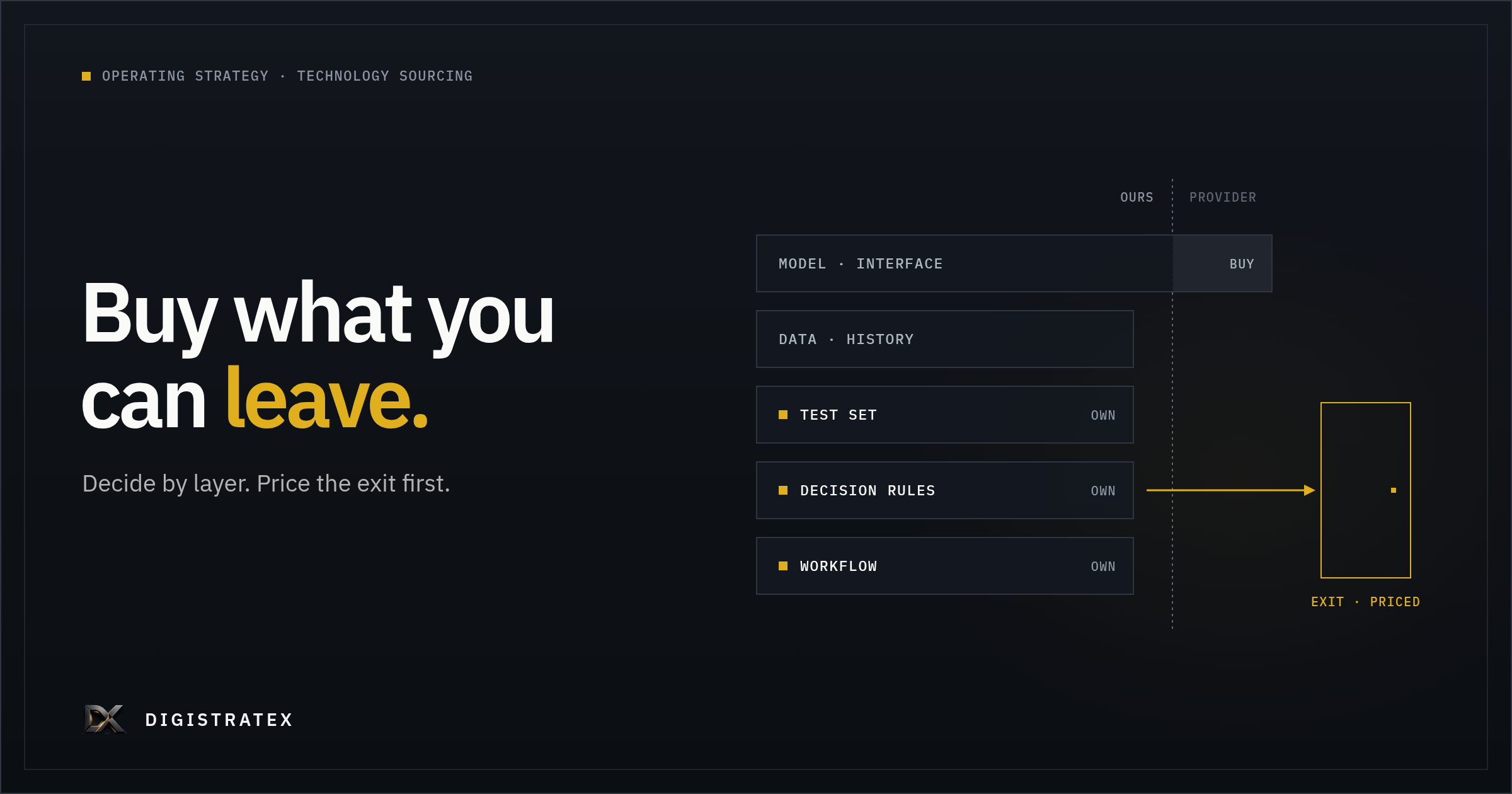
- The model and the interface. These change fastest and differentiate least. Buy them, and expect to replace them.
- The data and the labeled case history. The record of what happened and what the right answer turned out to be. Own it, in a format you can read without the vendor.
- The test set. A fixed set of real cases with known correct outcomes, used to judge any system before it goes live. Own it. It is the asset that makes leaving possible, because it lets you prove a replacement works.
- The decision rules. Thresholds, policies, and escalation rights. Own them as documents your organization governs, then configure them into whatever tool you use. Never let the tool be the only place they exist.
- The workflow design. How the work moves, who touches it, and what the customer or resident experiences. Build or redesign it yourself if it is how you compete or how you deliver a public duty. Otherwise adopt a standard one and spend your energy elsewhere.
Some illustrations, not client cases:
- Permitting. A city buys an AI intake tool. The model is the vendor's. The completeness rules for an application are the city's, published and versioned outside the product.
- Distribution. A wholesaler buys AI invoice matching. The tolerance thresholds and the history of disputed invoices stay in its own systems.
- Claims. A payer partners on AI review of a narrow claim type. It keeps the test set of adjudicated claims and runs every model update against it.
This is how the context we described in The Next AI Advantage Will Come From Business Context actually survives a change of provider. It survives because the contract and the sourcing choice were structured to keep it.
Partner means buy, plus knowledge transfer in writing
"Partner" is the most comfortable answer on the slide and the least defined. Usually it means the vendor builds with you. The risk is that the partner ends up understanding your operation better than you do.
The federal government has already written down what to ask for. OMB's current AI acquisition guidance, M-25-22, says lock-in protections "include requirements for vendor knowledge transfers, data and model portability, providing agencies with rights to code and models produced in performance of a contract, and transparency in licensing and pricing." It calls such terms "necessary to reduce the risk that switching vendors could become cost-prohibitive."
Business and public-sector leadership teams can borrow that list as written. A partnership without a knowledge-transfer obligation is a purchase with a longer onboarding.
Price the exit before you choose
The exit cost is the effort, time, and risk of running the same work with a different provider. Estimate it before you pick a route, the same way you estimate the cost of entry.
Then rehearse it once before go-live. Export the case history and open it without the vendor's tools. Run the test set against a second system, even a crude one. Ask the internal owner to walk through the decision rules without the vendor in the room.
If that rehearsal fails, the answer is not necessarily to build. It is to fix the contract, the data format, or the internal ownership before you sign. If no one can say what leaving costs, you have not chosen. You have been chosen.
The Exit-Priced Sourcing Scorecard
| Criterion | Accountable Owner | Evidence Required | Red Flag |
|---|---|---|---|
| 1. Where the layer sits | Business executive who owns the workflow | Each layer marked own, buy, or partner, with the reason | One answer for the whole system |
| 2. Decision rules held outside the tool | Process owner + risk or legal lead | Versioned rule documents the organization governs | Rules exist only as vendor configuration |
| 3. Case history you can read | Data owner for the workflow | Full export opened and queried without vendor software | Export is a raw dump no one has tested |
| 4. Owned test set | Operations analytics lead | Real cases with known outcomes; every model update scored against it | Vendor supplies its own accuracy figures only |
| 5. Knowledge transfer | Executive sponsor + procurement or contracting lead | Written transfer plan, documentation, and rights to work produced | "Partner" with no transfer obligation |
| 6. Exit priced and rehearsed | CFO or budget director | Estimated cost and time to switch (working assumption: within 90 days), one rehearsal completed | No exit estimate in the business case |
The Question for the Board
The build, buy, or partner slide will keep coming. The better question sits underneath it.
So before the next AI or operations technology contract comes for approval, ask:
If we had to leave this provider in 90 days, what would it cost, and who would still know how the work runs?
If the team cannot answer, the decision is not ready, whichever box the slide has ticked.