
Qantas Plans to Hand About 850 Jobs to Accenture Before the AI Arrives. Who Keeps the Savings?
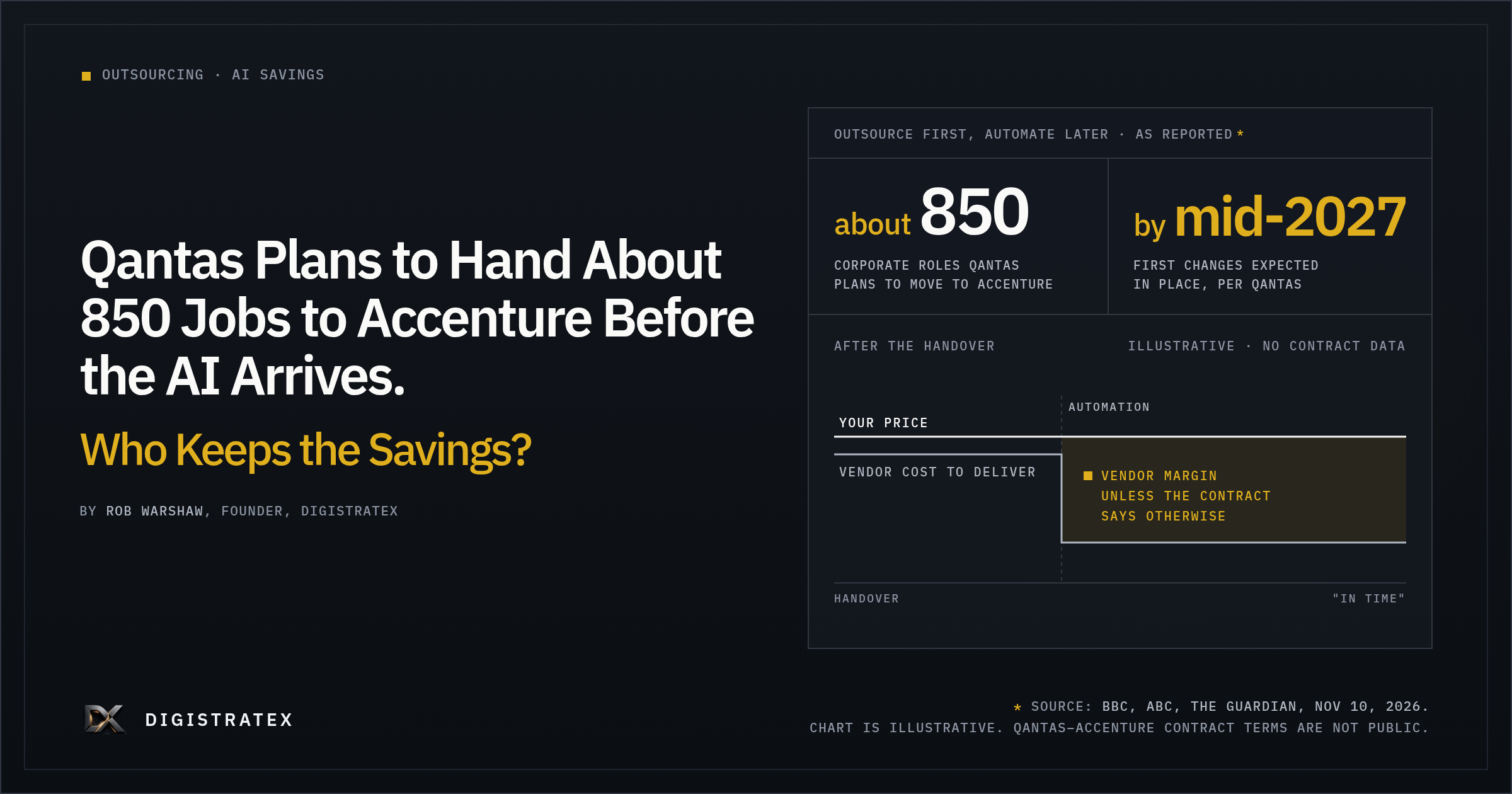
Last Tuesday, Qantas told its staff that it plans to move about 850 corporate roles to Accenture under a new multi-year deal. The BBC reported that the first changes are expected to be in place by mid-2027, beginning with finance, procurement, people and marketing, and will be delivered "mostly" by Accenture teams in India and "some in Australia." The coverage called it an AI overhaul. The Guardian's headline said so directly. Investors liked it: ABC News reported that Qantas shares rose more than 6% that day.
Read the company's own words, though, and the order of events is different. According to the BBC, Qantas said that "in time," the work Accenture takes over will be "transformed further with automation and AI."
In time. After the handover.
That is not a criticism of Qantas's need to act. CEO Vanessa Hudson described "more than 1,000 legacy applications that were never designed to work together" and more than AU$1 billion a year in technology spending. Few large organizations could fix that alone. The point is about sequence, and it applies to every leadership team now weighing an outsourcing or systems-integration deal with "AI" in the pitch: when you hand over a process before you redesign and automate it, someone else will do the redesign and the automation. Unless the contract says otherwise, they keep most of what it is worth.
Outsourcing first, automating later, moves the savings
A traditional outsourcing deal prices a process roughly as it runs today: a volume, a service level, a rate. The buyer's savings come from labor arbitrage and from the vendor running the work more tightly.
Automation changes that math after the ink is dry. This is my analysis, not a sourced figure, but the logic is simple. If the vendor later automates half of the work it took over, its cost to deliver falls sharply. The buyer's price falls only if the contract forces it to. Otherwise, the difference becomes vendor margin. The automation dividend, which was the reason the board approved an "AI-driven" transformation, lands on the other side of the table.
Qantas is not an outlier in Australia. ABC noted that Telstra announced an A$700 million joint venture with Accenture last year and that Coles has reportedly moved up to 1,000 jobs offshore after partnering with the firm. The pattern is common enough that the contract terms matter more than the press release.
The asset that leaves is not the labor
When people leave with a process, the obvious loss is headcount. The bigger loss is what they know.
Finance, procurement and HR operations run on judgment that rarely makes it into a procedure manual: which supplier invoices always need a second look, which approval chains exist only because of a system that never talked to another system, which exceptions are real and which are habit. That knowledge is exactly what an AI redesign needs. It is how you decide which steps to retire and which rules to encode.
Hand the process to a vendor and that knowledge rebuilds on the vendor's side, in the vendor's tools, under the vendor's documentation. Two or three years later, when you want to automate further, renegotiate or bring the work back, you are asking someone else to tell you how your own company works.
To be fair to Qantas, Hudson said the deal will also "redesign and simplify parts of how our corporate functions work and reduce duplication." The question for any buyer is who owns that redesign: whose people make the decisions, whose system of record holds the result, and who can see it.
This is not just a big-company problem
The same decision shows up at every size. A mid-sized manufacturer hands accounts payable to a BPO. A health plan outsources member-service overflow. A state agency or a town moves benefits processing, permitting intake or a call center to a contractor. Each vendor will, sooner or later, put automation into the work. Each buyer will either share in that gain or pay last year's price for a cheaper process.
Public-sector buyers face an extra constraint. A contract signed today may run through two budget cycles and an election, and taxpayers will expect the savings from automation to show up in the budget, not in a vendor's margin.
Five terms to settle before you outsource a process you plan to automate
None of these require walking away from a vendor. They require deciding, before signature, who owns what the vendor learns and saves.
| Contract term | What to require | Accountable owner | How you verify it |
|---|---|---|---|
| 1. Redesign ownership | Your team approves the future-state process; decision rights, approval layers and policy rules stay yours | Business-function executive (CFO, CHRO, agency director) | Signed future-state process map held in your system, updated at each change |
| 2. Automation pass-through | A defined share of vendor cost reductions from automation flows back as lower unit price, on a schedule | CFO / procurement lead | Annual unit-cost review against a baseline you measured before handover |
| 3. Process knowledge rights | Procedures, exception rules, prompts, workflow configurations and training data built on your work are your property and delivered on request | Process owner + legal | Quarterly documentation delivery, spot-checked by your own staff |
| 4. AI change approval | No new automation or AI agent touches your customers, employees, suppliers or money without your written sign-off and audit log access | COO / chief risk or compliance officer | Change log reviewed monthly; any unapproved automation is a contract breach |
| 5. Step-back plan | A tested path to move the process to another vendor or back in-house, with knowledge transfer included | CEO / board sponsor | Tabletop exercise before signature and every two years |
Two of these deserve emphasis.
Term 2 needs a baseline you own. If the only measure of the process's cost is the vendor's invoice, you cannot tell how much automation saved. Measure volume, cycle time, error rates and cost per transaction before the handover, using your own data.
Term 3 decides whether you can ever automate on your own terms. If the rules your vendor encodes become its intellectual property, you have outsourced the know-how along with the work.
The question for the board
Outsourcing can be the right call. A company with 1,000 legacy applications may need a partner with scale to fix them, and the people affected deserve a clear plan and honest communication, whatever the decision.
But "AI-driven" is not a reason to sign. Before approving any deal that promises automation later, a board, a CEO or a town council should be able to answer one question:
When the vendor automates this work, how much of the savings comes back to us, and who will understand how the process works?
If the answer is "we'll negotiate that later," the vendor already has.