
Walmart Automated the Warehouse. Measure the Store That Receives the Freight.
On Walmart's fourth-quarter call in February, CFO John David Rainey gave two numbers that most automation programs would be proud of. In Walmart US, he said, "approximately 60% of stores are receiving some freight from automated distribution centers, and approximately 50% of eCommerce fulfillment center volume is automated." He credited the automation with better visibility into inventory and "improved our labor productivity." (Walmart's Q4 FY26 earnings materials; call transcript.)
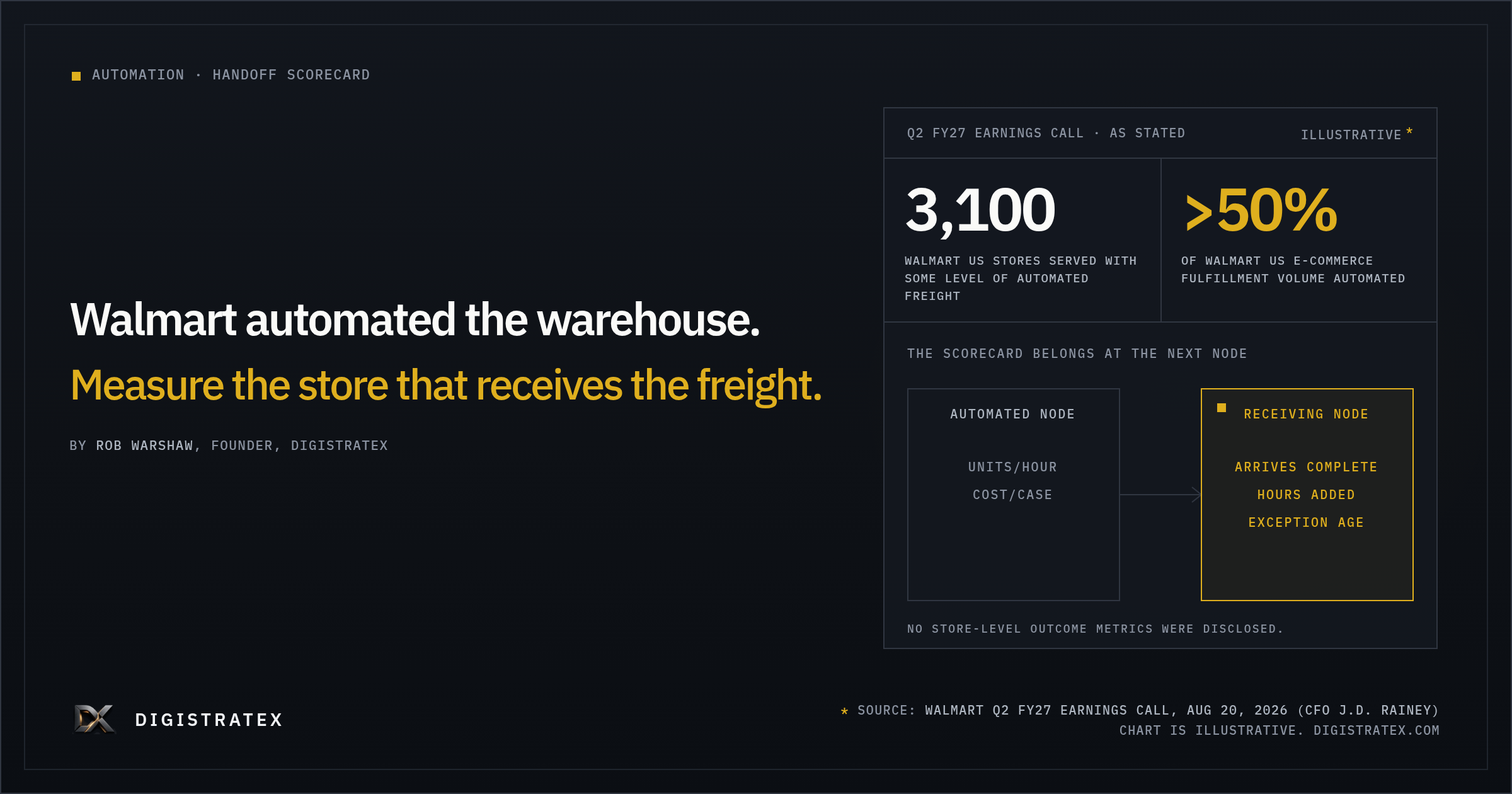
By the second-quarter call in August, Rainey put it at "3,100 of our US stores" served "with some level of automated freight," and "over 50%" of e-commerce fulfillment volume processed through automated facilities. (Q2 FY27 earnings materials; call transcript.)
The usual reading is that warehouse automation works. The more useful reading for operators came a moment later on the February call. Walmart is "increasingly leveraging stores as digital fulfillment nodes," Rainey said, and "when you simplify our model, inventory and labor are our two largest costs."
Inventory and labor are not only costs inside the automated building. They also sit in the store that receives the freight.
That is the point of this piece. When you automate one step in a chain, the scorecard that tells you whether it worked belongs at the next step, the one that receives the automated step's output. Most programs measure the automated step instead.
What Walmart measured, and what it didn't say
Read the transcripts carefully and the hedges matter. In February, "approximately 60%" of stores received "some" freight from automated centers, and in August the 3,100 stores were served with "some level of automated freight," not all of it. The 50% figure is a share of e-commerce fulfillment volume, not of stores. Walmart did not report store-level receiving time, stocking labor, or exception rates on either call, and I won't guess at them.
What Walmart did describe is a system that reaches past the warehouse. CEO John Furner said that more than a million US associates carry handheld devices that use computer vision "to map our inventory, to know what we have, to know exactly where it is." He called it "a system from end to end." Rainey tied the supply-chain work to "fewer fresh throwaways, better inventory management... fewer markdowns," which are outcomes you only see after the freight lands. Furner also said Walmart "ended the quarter with inventory up 2.6%, or about half the rate of sales growth."
In other words, Walmart describes its automation benefits in terms of what happens downstream. Many automation business cases are written in terms of the automated node instead: units per hour, cost per case, volume processed.
Why the automated node's scorecard misleads
This is analysis, not a Walmart finding. Automation changes the shape of what it hands off. A DC can ship faster and more accurately and still send a store pallets that arrive at the wrong hour, in the wrong sequence, or built for the machine's efficiency rather than the aisle's. Every one of those costs shows up in the store's labor and in its shelves. None shows up in the DC's units per hour.
The pattern is not about warehouses. We have argued before that technology accelerates local optimization. This piece is about the instrument that catches it: measure the receiving node, give it an owner, and don't call the automation done until that node improves.
The same handoff exists wherever automation sits upstream of people. Some illustrations, not client cases:
Claims. A health plan raises its auto-adjudication rate. The claims that fall out now arrive at the pend queue harder and older, and providers call to ask why. The automated metric goes up. The provider-services team absorbs the difference.
Clinical intake. A health system automates referral intake. Referrals move faster, but if they arrive at the specialty clinic without the imaging or the prior-authorization status, the clinic's schedulers do the chasing, and the patient waits anyway.
Public-sector case handoffs. An agency moves applications online. Submissions jump. If the portal accepts incomplete applications, the caseworker who receives them inherits the missing documents and the call-backs.
In each case, the upstream dashboard is green and the downstream team is buried. Nobody is lying. The scorecard is attached to the wrong node.
The handoff scorecard
Keep the automated node's metrics. Add the receiving node's metrics beside them, and make the receiving node's leader the owner of the result.
| Measure | Automated-node metric (what most programs report) | Downstream-handoff metric (what decides success) | Accountable owner | How to verify |
|---|---|---|---|---|
| Flow | Volume processed, cycle time inside the node | Share of handoffs that arrive complete, on time, and usable without rework | Leader of the receiving node (store, clinic, claims operations, case unit) | Sample of arrivals inspected at the receiving end each week, not the sender's shipment log |
| Accuracy | What the system says it sent | What the receiving node can actually sell, schedule, pay, or decide | Receiving-node leader with finance | Physical or record counts at the receiving node, reconciled to the sender's data |
| Labor | Hours removed at the automated node | Hours added downstream for receiving, rework, chasing, and call-backs | COO or CFO, netting both nodes | Time and staffing data at both nodes, before and after go-live, same baseline period |
| Exceptions | Error rate at the automated node | Age, volume, and owner of exceptions the receiving node must clear | Receiving-node leader | Queue and ownership-history data at the receiving node |
| Customer | Usually none | Outs, substitutions, provider or member call-backs, missed appointments, applicant re-contacts | Executive who owns the customer outcome | Customer-facing data, independent of either node's own reporting |
Three rules make it work.
Measure the net, not the gross. Labor saved upstream minus labor added downstream is the automation's labor result. If you report only the first number, you are reporting a transfer.
Give the receiving node a veto on "done." The automation is not complete until the downstream column holds steady or improves for a defined period. The upstream team should want this. It is the only evidence that will survive a CFO's review.
Invest in the receiving end on purpose. Walmart's handhelds are a reminder that the downstream node often needs its own tools to take full advantage of a faster upstream. Fund that in the same business case, not as a later fix.
What this asks of leadership
This is a measurement decision, not a technology decision. Business and public-sector leadership teams can make it this quarter for any automation already live.
Pick the automated step you are proudest of. Find the team that receives its output. Ask that team's leader three questions: what arrives incomplete, what extra work have you picked up, and who owns it when it goes wrong? Then compare their answers to the upstream dashboard.
If the two pictures match, the automation is working. If they don't, you have found where the savings went.
The question for the board
Before the next automation milestone is declared a success, a CEO or board should ask one question:
What happened at the step that receives this automation's output, and who on the leadership team owns that number?
If nobody owns that number, you can't yet say whether the automation worked.