
The Health Insurance Industry Is in the ER. Is AI the Cure?
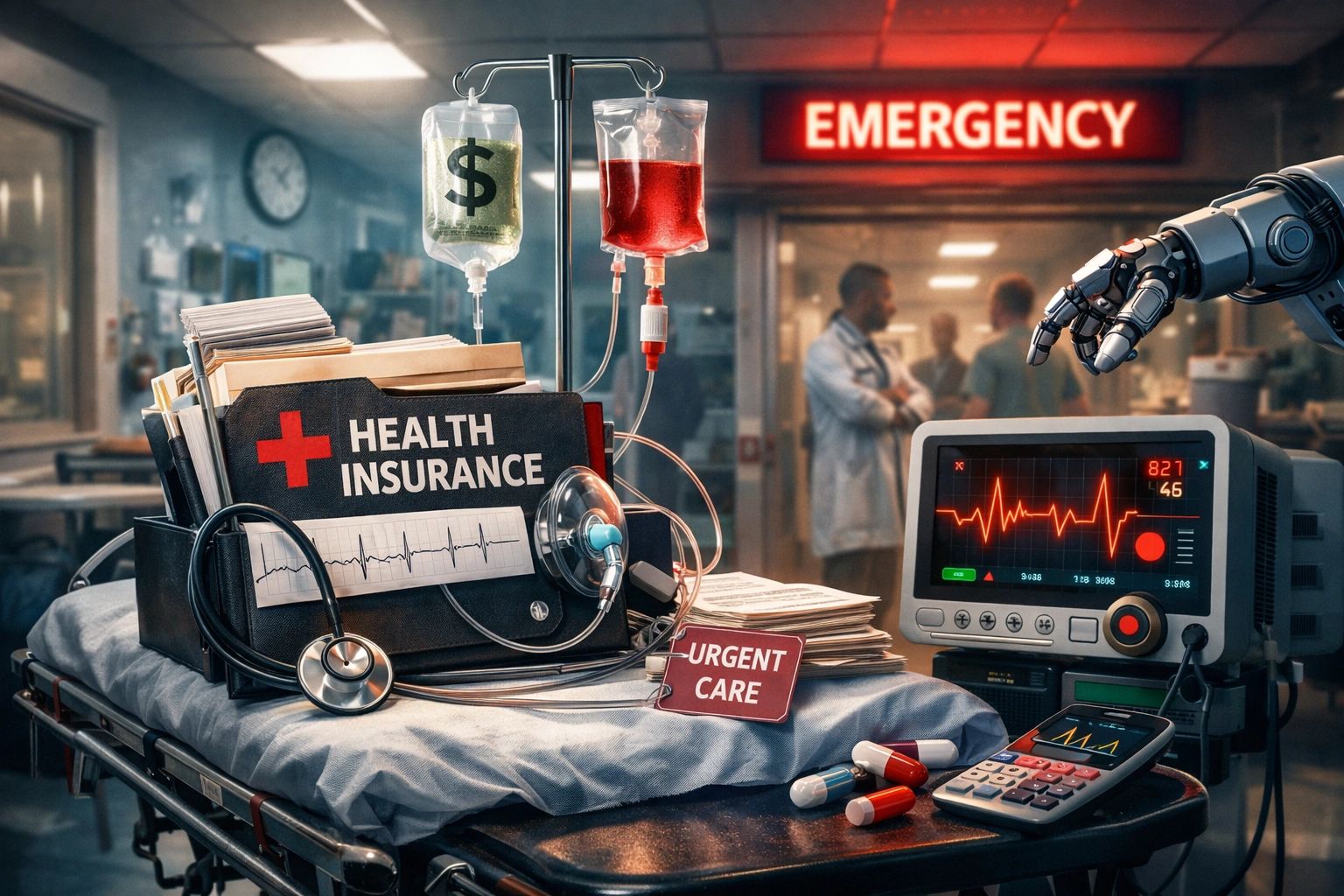
If the U.S. health insurance industry walked into a hospital today, it wouldn’t be checking in for a routine physical.
It would be rushed straight into the emergency room.
Vitals unstable.
Systems overwhelmed.
Staff burned out.
Patients frustrated and angry.
Costs spiraling with no clear line of sight to recovery.
The question leaders are quietly asking isn’t “How do we optimize?”
It’s “Can we stabilize this patient before something critical fails?”
And that’s where AI enters the conversation—not as a miracle drug, but as a powerful tool in triage, diagnosis, and long-term rehabilitation.
Symptoms: Why the Industry Is in the ER
Every ER visit starts with symptoms. The health insurance industry has plenty:
1. Administrative Overload
Prior authorizations, appeals, manual reviews, phone calls, faxes, duplicate data entry.
The system is drowning in work that adds cost but not care.
This is the equivalent of a patient whose organs are fine—but whose circulatory system is clogged.
2. Rising Costs With Diminishing Trust
Premiums go up. Coverage feels narrower. Explanations get more confusing.
Members don’t feel cared for—they feel processed.
That’s not a bedside manner problem.
That’s a system design problem.
3. Workforce Burnout
Clinical reviewers, claims processors, call-center reps, nurse reviewers—many are exhausted doing work that feels repetitive, thankless, and impossible to “win.”
An ER can’t function when the staff is collapsing mid-shift.
4. Regulatory Pressure
Medical Loss Ratio requirements. Access rules. Transparency mandates. Audit risk.
Leadership teams are making life-or-death decisions with incomplete, delayed, and fragmented information.
That’s practicing medicine without a monitor.
Triage: What AI Can Do Immediately
In an ER, the first goal isn’t a full recovery—it’s stabilization.
AI shines here.
🩺 Triage the Work
AI can instantly classify:
- Claims that are clean vs. complex
- Authorizations that are routine vs. high-risk
- Appeals that need clinical judgment vs. administrative cleanup
This alone can remove 30–50% of unnecessary human touch—without denying care.
🧠 Decision Support, Not Decision Replacement
AI doesn’t need to decide care.
It needs to surface context:
- Similar historical cases
- Relevant guidelines
- Missing documentation
- Risk signals
Think of it as the attending physician who has already read every chart ever written.
⏱️ Speed Where Speed Matters
Delays are expensive—financially and reputationally.
AI compresses cycle times:
- Faster authorizations
- Quicker claims resolution
- Shorter appeals windows
In healthcare, time is cost.
Diagnosis: The Deeper Problem AI Exposes
Here’s the uncomfortable truth:
When you apply AI to health insurance operations, it doesn’t just automate inefficiency—it reveals it.
AI quickly exposes:
- Broken workflows
- Conflicting policies
- Redundant reviews
- Rules that no longer make sense
This is the CT scan moment.
And many organizations aren’t ready for what the scan shows.
Treatment Plan: AI Alone Is Not Enough
No ER doctor would say, “We ran the tests—good luck.”
AI only works if paired with:
- Operating model redesign
- Clear clinical and business intent
- Change management that respects people
- Governance that earns trust
Otherwise, AI just helps you do the wrong things faster.
Recovery: Can the Industry Actually Get Healthier?
Yes—but only if leaders stop thinking of AI as a cost-cutting tool and start seeing it as a system-stabilizing capability.
A healthier future looks like:
- Fewer manual reviews, more clinical focus
- Clearer member communication
- Lower administrative waste
- Faster, fairer decisions
- Staff doing work that actually requires human judgment
That’s not science fiction.That’s available right now.
Final Thought: The ER Is a Wake-Up Call
The emergency room is not a place of failure.
It’s a place of urgency.
The health insurance industry is there today—not because it’s broken beyond repair, but because the old ways can’t keep it alive.
AI won’t magically heal the system.
But used correctly, it can:
- Stop the bleeding
- Restore vital signs
- And give leaders the clarity needed to design a healthier future
The patient is critical—but stable.
What happens next depends on whether leadership chooses real treatment…or just another temporary fix.