
The AI ROI Problem: Why Companies Can’t Find the Savings
Companies are spending billions on AI.
Employees are getting copilots. Developers are using coding assistants. Customer service teams are deploying bots. Companies are building agents and announcing major productivity gains.
Then the CFO asks:
Where are the savings?
That question exposes one of the biggest problems with enterprise AI today.
Companies are getting better at using AI, but not necessarily at capturing its economic value.
Productivity Isn't ROI
Imagine AI makes 1,000 employees 30% more productive.
Six months later, the company still has 1,000 employees. Salaries haven't changed. Benefits haven't changed. Overhead hasn't changed.
The employees may be accomplishing more, but where does the 30% productivity improvement appear on the P&L?
Often, it doesn't.
Saving 20% of someone's time doesn't automatically save 20% of their salary.
That's the AI ROI problem.
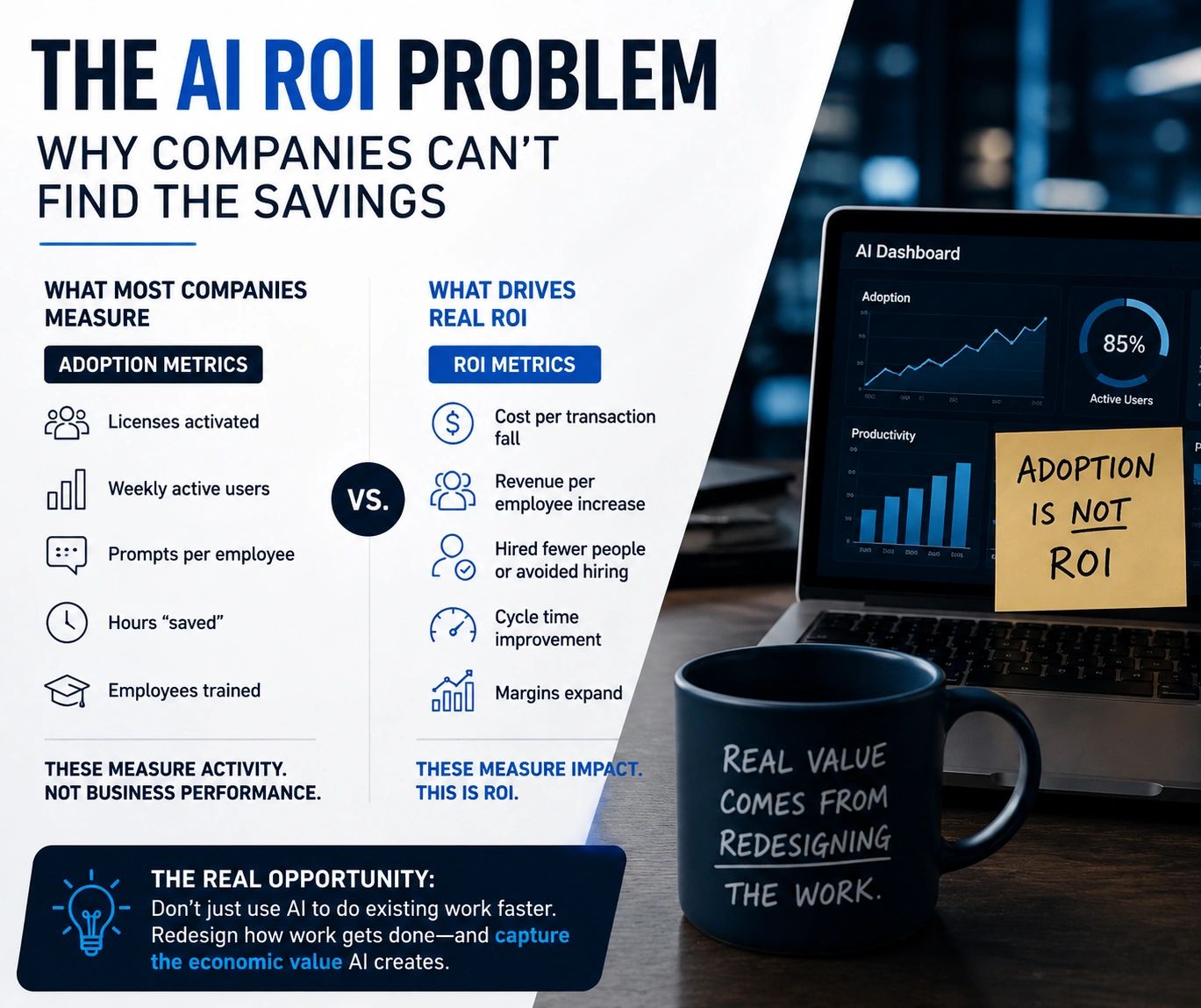
Stop Measuring Adoption
Many companies measure AI success through metrics like:
- AI licenses activated
- Weekly active users
- Prompts per employee
- Hours "saved"
- Employees trained
These measure AI adoption, not business performance.
A company could achieve 90% AI adoption while producing almost no improvement in operating margin.
The better questions are:
Did cost per transaction fall?
Did revenue per employee increase?
Did we avoid hiring?
Did cycle time improve?
Did margins expand?
Those are AI ROI metrics.
Stop Automating Tasks
Most companies are currently using AI to make existing work faster.
Write the email.
Summarize the meeting.
Analyze the spreadsheet.
Create the presentation.
That's useful, but incremental.
The larger opportunity comes from asking:
Why does this work exist in the first place?
Instead of using AI to make seven people involved in a process 20% faster, redesign the process so AI handles most of the transaction and humans manage the exceptions.
That's where the economics change.
AI Needs a P&L
Every major AI initiative should start with a baseline:
What does this process cost today?
Then measure what happens after AI.
Not prompts.
Not licenses.
Not estimated hours saved.
Actual economics.
There are only a handful of ways productivity ultimately becomes financial value: lower operating expense, increased output, avoided hiring, higher revenue, or better customer economics.
If none of those change, companies should be careful about calling productivity gains ROI.
The Next Phase of AI
The first phase of enterprise AI has largely been about technology.
The next phase will be about operating models.
The question will shift from:
"What can AI do?"
to:
"What did AI change?"
The companies that generate the greatest returns won't simply give every employee an AI assistant.
They'll redesign how work gets done.
And they'll ask a much more powerful question:
If we were building this company today, knowing what AI can now do, would we design it this way?
For many companies, the answer will be no.
That's where the real AI ROI is hiding.