
Microsoft Spent $116 Billion on Infrastructure Last Year. Read Its 10-K Before Your Next Cloud Renewal.
Most cloud and AI renewals are negotiated from the buyer's side of the table: last year's invoice, this year's usage forecast, a discount target. The supplier's side gets one line in the deck, usually "strategic partner."
That is a mistake, because the largest suppliers have already written down, under securities law, what their cost pressures are and what they may do about them. Your supplier's risk factors are a preview of your renewal.
What Microsoft told its investors
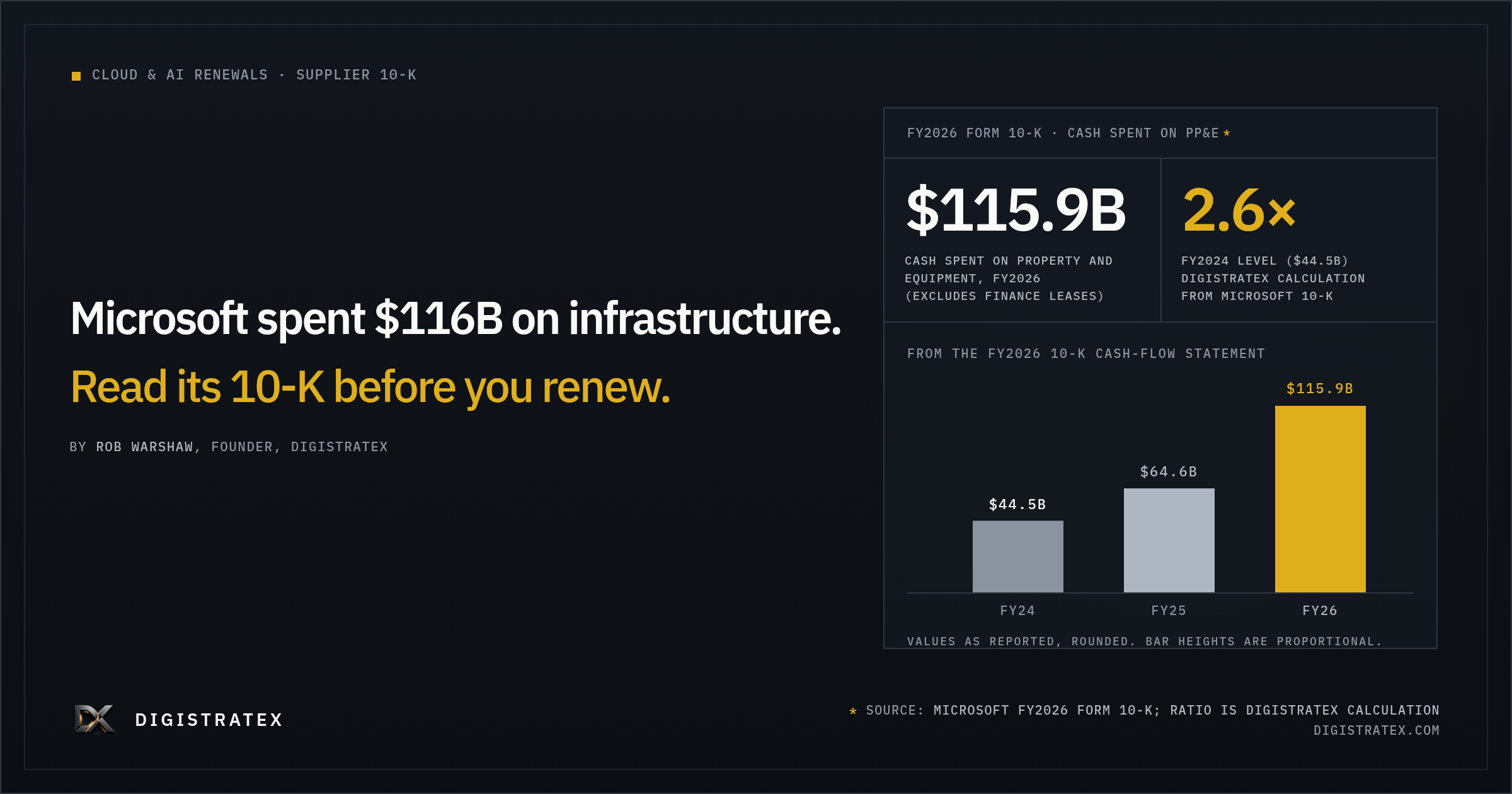
Microsoft's fiscal 2026 annual report, available from its 2026 Annual Report download center, shows additions to property and equipment of $115.9 billion for the year ended June 30, 2026. That compares with $64.6 billion in fiscal 2025 and $44.5 billion in fiscal 2024. Revenue was $331.8 billion and cash from operations was $182.9 billion.
Our calculation, not a figure Microsoft states: cash spending on property and equipment (which excludes finance leases) equaled about 34.9% of revenue and 63.4% of operating cash flow, and it was roughly 2.6 times the fiscal 2024 level.
The Form 10-K explains where the pressure sits. Microsoft Cloud gross margin "decreased to 66% driven by continued investments in AI infrastructure and growing AI product usage." In its risk factors, Microsoft says "the cost structure for AI products and services is subject to significant uncertainty, including with respect to model training and inference costs, the availability and pricing of components, and energy costs." It adds that if those costs "increase, remain elevated, or fail to decline," margins could suffer.
Then comes the sentence I would put in front of every renewal team: "As we manage infrastructure capacity constraints and evolving customer demand, we may modify capacity allocations, deployment priorities, pricing, or other commercial arrangements."
That is not a forecast of what Microsoft will charge anyone. It is a disclosure of the levers it has reserved. Price is one. Capacity allocation is another.
Oracle was more direct about fixed prices
Oracle's fiscal 2026 Form 10-K is more direct about the customer contract. Power for AI compute is "constrained globally," and "increases in energy costs can adversely affect our margins, particularly where customer pricing is fixed or committed." Oracle also says "the terms, renewal options and pricing adjustments in our long-term data center leases typically do not align with the duration and pricing of customer contracts."
Oracle's cash-flow statement shows $55.7 billion of capital expenditures against $32.0 billion of cash from operations for the year ended May 31, 2026.
Read as a buyer, that tells you two things. A fixed or committed price is a cost to the supplier, so it has value to you. And the supplier's own commitments for buildings and power run on a different clock from yours.
What this means at the table
The following is my analysis, not something either company has said about its customers.
When a supplier is spending at this scale ahead of revenue (Microsoft's words are "in advance of fully developed revenue streams"), it has every reason to protect margin at renewal. That pressure tends to show up in places procurement does not always watch: the end of a promotional rate, a feature moved into a higher tier, a new unit of measure for an AI capability, or a region where the capacity you assumed is not available when you need it.
None of that requires bad faith. It is what a supplier does when its inputs are scarce and expensive. The question is whether your contract was written by someone who had read the same filing.
Microsoft also names the buyer's leverage. It warns that customers "may reduce, delay, or shift AI workloads to competing platforms, on-premises or local deployments, or other alternatives." That is the buyer's leverage, described by the supplier.
Five terms to settle before you renew
These apply to a hyperscaler agreement, a software contract with AI features attached, or a managed-service deal that runs on someone else's cloud. They work for a health plan, a manufacturer or a state agency. All five are analysis, built from what the suppliers disclosed.
| Renewal term | What to require | Accountable owner | How you verify it |
|---|---|---|---|
| 1. The unit you actually buy | Name every invoice line (seat, credit, token, compute hour, committed spend) and its current unit price, not the product name | Business executive who owns the workload, with IT finance | Monthly reconciliation of invoice lines to measured usage |
| 2. Price-change rights | Written notice period, a cap on renewal increases, and no new surcharge or re-tiering of features already licensed during the term | CFO / procurement lead | Renewal quote compared line by line with the prior unit price, before signature |
| 3. Capacity commitment | For any workflow that cannot wait, committed capacity in named regions and a remedy if allocation changes | COO or CIO for that workflow | Quarterly capacity review; a scheduled test that the committed capacity is available |
| 4. Term length chosen on purpose | Decide whether price protection or flexibility is worth more for each workload, and price both options | CFO | One-year and three-year scenarios in the renewal file, with the assumption written down |
| 5. A priced second option | A credible quote for moving or reducing the workload, used as leverage in the negotiation | Executive sponsor of the renewal | Quote dated within 90 days of signature |
Three of these deserve a word.
Term 3 is the one most buyers skip. Leadership teams treat capacity as the supplier's problem until a launch slips. Microsoft has told its investors that power and component limits "could restrict our ability to develop or expand datacenter capacity." If a clinical, claims or customer workflow depends on that capacity, it belongs in the contract, not in an account manager's assurance.
Term 4 follows from Oracle's disclosure. If a supplier says fixed prices squeeze its margins when energy costs rise, a multi-year fixed price is something it will charge for. Sometimes it is worth paying. Decide that deliberately for each workload rather than accepting whatever term the quote defaults to.
Term 5 is not an exit plan. It is a renewal tool. A dated quote from an alternative is the most concrete evidence you can bring to a negotiation, and Microsoft's own risk factors say why it matters.
Who should read the filing
In most organizations, the analysis of a supplier's own economics is not in the renewal file. If it exists at all, it sits in one person's head.
Make it a routine. Ninety days before any renewal above a set threshold, someone reads the supplier's latest annual report, the risk factors and the capital spending lines, and writes one page: what the supplier says is getting more expensive, what levers it has reserved, and which of the five terms that changes. Give that page a named owner on the business side, not only in procurement.
The question for the board
Microsoft and Oracle have told their investors, in writing, that AI infrastructure costs are uncertain, that capacity is constrained, and that pricing and allocation may change. Their investors have that information. Your renewal team should too.
Before the next major cloud or AI renewal is approved, a CEO or board should be able to answer one question:
If our largest technology supplier changes price or capacity at renewal, what in this contract protects us, and who on our team read the filing that warned us?