
Intuit's Human-Expert Tier Is Now 53% of TurboTax Revenue. Design AI for the Expert, Not the Deflection.
The most-discussed AI goal in service businesses is deflection. Let the model answer more, route fewer cases to people, and report the containment rate to the board.
Intuit's latest annual results point the other way.
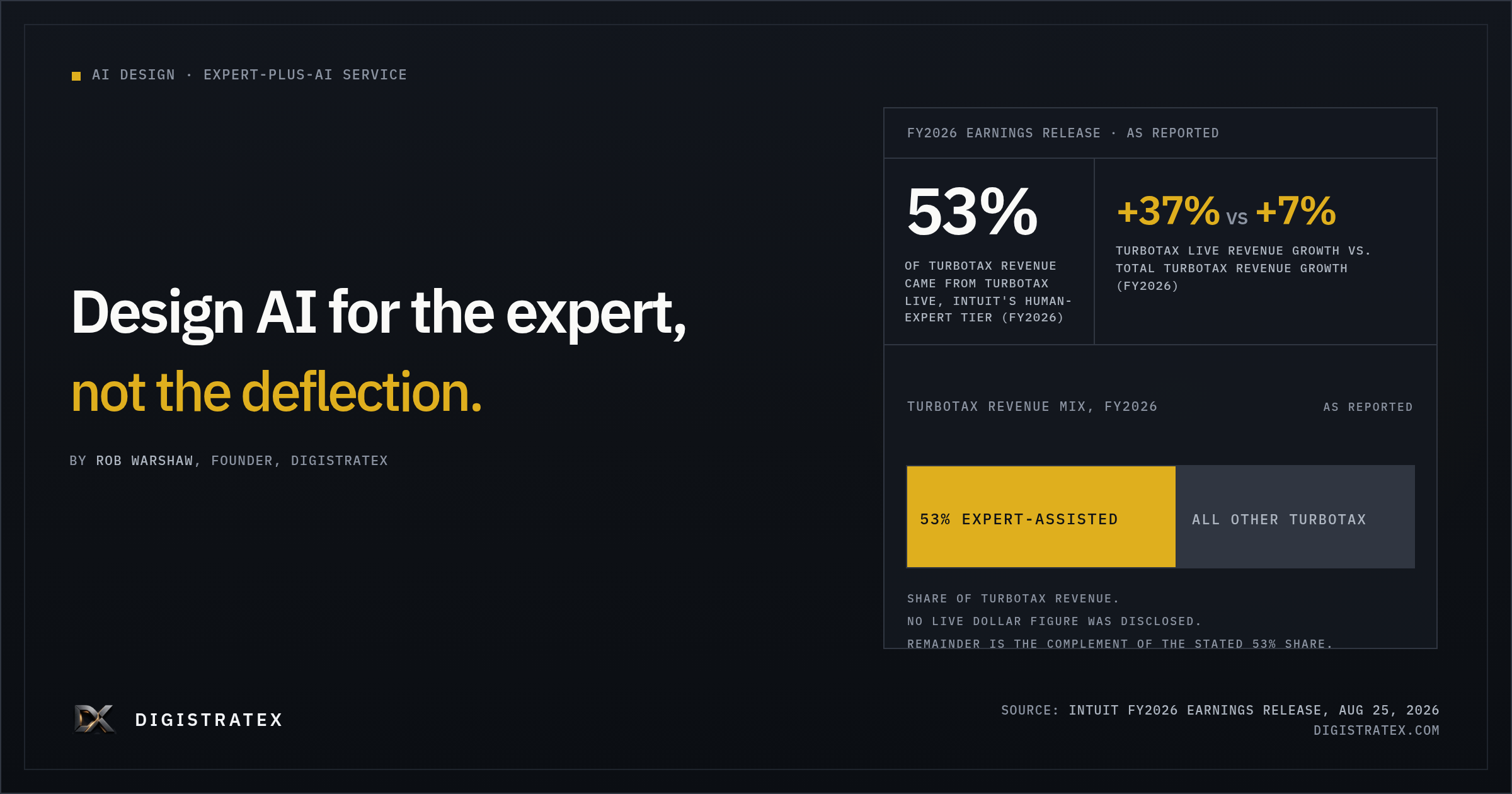
In its fiscal 2026 earnings release, issued in late August, Intuit reported: "TurboTax revenue increased 7 percent to $5.3 billion. TurboTax Live revenue increased 37 percent, representing 53 percent of total TurboTax revenue." TurboTax Live is the assisted tier, where a tax expert helps the customer or prepares the return. In the same release, total U.S. TurboTax units fell 2%, from 39.9 million to 39.0 million.
Fewer returns filed. More revenue. And more than half of that revenue now comes from the product with a human in it.
My read is that the lesson for leadership teams is not about tax software. When customers will pay for a correct outcome, AI's best job may be to make experts faster and more accurate, not to keep customers away from them.
What Intuit actually disclosed
The numbers are worth stating precisely, because they are easy to stretch.
These figures are sourced. Live grew 37% while TurboTax overall grew 7%. Live was 53% of TurboTax revenue. Units declined 2%. In its Form 10-K, Intuit attributes the TurboTax revenue increase to "growth in assisted tax and our consumer money offerings, partially offset by a decrease in revenue due to fewer TurboTax federal units."
The next figures are our arithmetic, not Intuit's. Fifty-three percent of $5.3 billion is about $2.8 billion of Live revenue. Working backward from the rounded growth rates, Live was roughly 41% to 42% of TurboTax revenue a year earlier. Live grew about five times as fast as TurboTax as a whole.
The trend has a limit Intuit itself named. On its fourth-quarter earnings call, Intuit said more than three-quarters of this year's Live customer additions came from do-it-yourself customers upgrading, and it expects Live revenue growth to slow to the mid-teens in fiscal 2027 because fewer of them will upgrade.
Here is what Intuit did not disclose: the margin on Live compared with do-it-yourself filing, expert handle time, or an accuracy rate for the expert path. So nothing here says Live is the more profitable product. The data says it is where the growth and the mix shift are.
Intuit describes AI as working beneath the expert
Intuit is not shy about AI. Its CEO, Sasan Goodarzi, said in the release: "Our strategy is to win as an AI-driven expert platform." The 10-K states the design more plainly: "We connect customers to AI-enabled human experts for that last mile of decisions or to complete the work for them."
The important words are "AI-enabled human experts." In this model, the expert is not the fallback when the bot fails. The expert is the product, and the AI sits underneath: gathering the customer's data, preparing the work, and handing the expert a case that is closer to finished.
That is a different design brief from deflection. It changes what you measure, who you hire, and what you count as success.
Why deflection is the wrong scoreboard for some services
Containment is a fine measure for questions with one right answer and low stakes. Where is my card? What is my balance? When is my appointment?
It is the wrong primary measure when the customer is making a consequential decision and is willing to pay for confidence. Those are the moments when customers most want a person to stand behind the answer. Push hard on deflection there and you risk starving the path that may be both the growth engine and the quality floor.
Intuit names the risk itself. Its 10-K warns that "these experts may provide advice that is erroneous, ineffective or otherwise unsuitable." An expert path is not automatically a quality path. It needs a standard, and AI can help hold it.
The same design applies far beyond tax
The following applications are my analysis, not Intuit's claims.
Health-plan member navigation. A member choosing between a surgeon in network and one out of network, or sorting out a denied claim, is not looking for a faster chatbot. Give the navigator AI that assembles the claim history, benefits, prior authorizations and cost estimates before the conversation starts.
Benefits administration. Retirement elections, leave and disability claims are high-stakes and rule-heavy. AI can draft the case file and check eligibility. A specialist confirms the decision and explains it.
Lending. Small-business and complex mortgage borrowers often value a loan officer who can structure the deal. AI can verify documents and flag gaps so the officer spends time on structure, not paperwork.
Complex B2B service. In enterprise software, equipment and logistics, the customers worth keeping escalate to engineers and account teams. AI should shorten the engineer's diagnosis, not block the escalation.
Public-sector caseworkers. A caseworker's time is the scarce resource in benefits, child welfare and workforce programs. AI can prepare the file, check completeness and surface prior history so the caseworker spends more time with the person and less time searching.
A scorecard for an expert-plus-AI service
If the human path is a product, run it like one. Here is a scorecard I would put in front of an executive team before funding the next round of AI for any expert-assisted service.
| Metric | Baseline to capture first | Accountable owner | Quality guardrail | Validation method |
|---|---|---|---|---|
| Expert time per completed outcome | Current minutes per completed case, by case type | Head of the expert service line | No reduction counts if rework or reopen rates rise | Monthly time-and-motion sample against system timestamps |
| First-pass accuracy | Current error, amendment or reopen rate | Chief quality or compliance officer | Floor set before launch; AI-assisted cases may not fall below it | Independent blind review of a random sample each month |
| Assisted-path revenue and mix | Revenue, volume and share for assisted vs self-service paths, reported separately | CFO and product line P&L owner | No blending of assisted results into a single "digital" number | Quarterly segment report reconciled to the general ledger |
| Case readiness at handoff | Share of cases that reach the expert with complete data | Operations or platform leader | AI may prepare and route, not decide, on cases above a defined risk tier | Expert rates each handoff; weekly review of incomplete cases |
| Customer outcome and trust | Current resolution rate, complaints and retention for assisted customers | Customer experience executive | Escalation to a person is always available and never penalized | Customer survey plus complaint and retention tracking by path |
Two rows deserve emphasis.
Report the two paths separately. If more than half of a product's revenue already flows through the assisted path, as it does at TurboTax, a single blended "digital adoption" number hides the business that is growing.
Staff to the mix you have. Hiring, scheduling and training plans should follow the share of work on the expert path today, not a containment target in next year's deck.
The question for the board
Deflection has a place. Most organizations have plenty of simple contacts that should never reach a person.
But before approving the next AI investment in a service business, a CEO or board should be able to answer one question:
Which of our services do customers value precisely because an expert stands behind the answer, and is our AI built to make those experts better or to keep customers away from them?