
If You’re Using AI to Improve Processes, You’re Missing the Point
Most executives today are asking the wrong question about AI.
They’re asking:
- “How can we automate this workflow?”
- “How can we reduce headcount with AI?”
- “How can we make this report faster?”
Those are efficiency questions.
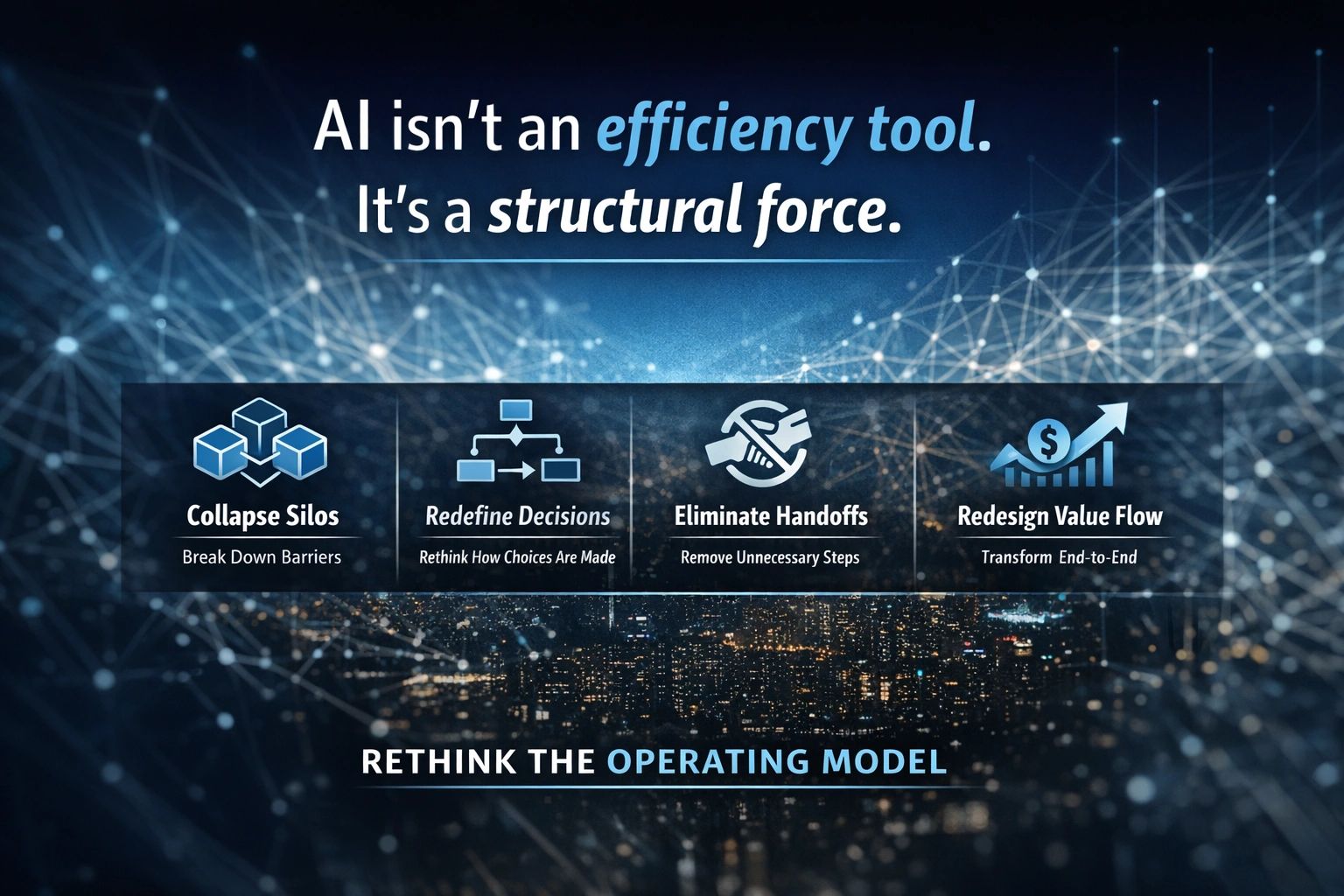
AI is not an efficiency story.
It is an enterprise redesign story.
And if leaders are spending most of their AI time optimizing existing processes, they are likely reinforcing yesterday’s operating model — not building tomorrow’s.
The Dangerous Comfort of Process Optimization
It’s natural to start with automation.
Take an existing workflow.
Make it faster.
Add copilots.
Reduce friction.
That feels responsible. Measurable. Contained.
But here’s the problem:
You are assuming the process itself still deserves to exist.
AI does not simply accelerate tasks.
It collapses steps.
It removes boundaries.
It redefines roles.
It eliminates entire handoffs.
When we apply AI to legacy processes, we often end up digitizing inefficiency.
It’s like paving a cow path.
Enterprise AI Is Not a Tool. It’s a Structural Force.
AI changes three foundational elements of an enterprise:
- Where intelligence lives
- How decisions get made
- How value flows end-to-end
Most companies still operate as if intelligence sits in silos:
- Sales has its data.
- Operations has its systems.
- Finance has its models.
- IT has its backlog.
AI collapses those walls.
When intelligence becomes ambient and cross-functional, the org chart stops being the primary architecture of work.
The workflow becomes dynamic.
The enterprise becomes composable.
That is not a process improvement.
That is an operating model transformation.
The End-to-End Lens Leaders Are Missing
If AI can interpret, predict, reason, summarize, recommend, and act…
Then why are we redesigning steps instead of redesigning journeys?
The real question is not:
“How do we automate underwriting?”
It is:
“If underwriting were designed today with AI native capabilities, would it even look like underwriting?”
Would roles shift?
Would approvals collapse?
Would customer engagement move upstream?
Would risk scoring become continuous instead of episodic?
Enterprise leaders must start at the value stream — not the task list.
Look at the entire journey:
- From customer acquisition
- To onboarding
- To service
- To exception handling
- To retention
Then ask:
If AI is a reasoning layer across all of this — what disappears? What accelerates? What becomes predictive? What becomes autonomous?
That is where transformation lives.
The Cost of Thinking Too Small
Companies that use AI to make existing processes 20% faster will get a short-term margin bump.
Companies that redesign their enterprise around AI capabilities will:
- Create new business models
- Reduce structural cost
- Improve experience in nonlinear ways
- Outpace competitors structurally, not incrementally
The difference is not 20%.
It is existential.
This is the same mistake companies made with the internet.
Some asked:
“How do we put our brochure online?”
Others asked:
“What business are we in now that distribution is free?”
Only one group won.
What Leaders Should Actually Be Doing
Instead of funding dozens of disconnected AI pilots, executive teams should:
1. Redesign One Core Value Stream End-to-End
Pick one — claims, sales, fulfillment, service.
Rebuild it from scratch assuming:
- AI can interpret all unstructured data
- AI can reason across systems
- AI can recommend and execute actions
- Humans handle only judgment and edge cases
Start there.
2. Redefine Decision Architecture
Map where decisions are made today.
Then ask:
- Which decisions can be automated?
- Which become augmented?
- Which move upstream?
- Which disappear?
AI shifts decision velocity and location.
That changes organizational structure.
3. Rethink Workforce Design
If AI handles synthesis, pattern recognition, and first-level drafting:
What does a manager do?
What does an analyst do?
What does a frontline rep do?
Roles will not shrink. They will elevate.
But only if leaders intentionally redesign them.
4. Elevate AI to Strategy — Not IT
AI is not a CIO initiative.
It is not an innovation lab experiment.
It is not a chatbot program.
It is a CEO-level structural lever.
If AI is not being discussed at the same altitude as capital allocation, M&A strategy, and operating model design — it is being underleveraged.
The Real Leadership Test
The hardest part of enterprise AI transformation is not technology.
It is imagination.
It requires leaders to question:
- The necessity of legacy structures
- The permanence of existing roles
- The boundaries between departments
- The sequence of work itself
It requires comfort with dismantling things that once worked.
Most organizations won’t do this.
They will automate forms.
They will build copilots.
They will celebrate incremental efficiency.
And they will miss the shift.
The Bottom Line
AI is not a faster engine.
It is a new map.
If leaders are only asking how to drive faster on yesterday’s roads, they are missing the opportunity to redraw the terrain.
The winners will not be those who automate tasks.
They will be those who redesign enterprises.
The question is simple:
Are you optimizing the past?
Or architecting the future?