
Northwell Pays About 400 People to Fight Insurance Denials. AI on Both Sides Won't End the Fight.
Last Tuesday, Google Cloud launched Gemini for Healthcare. As Fortune's Catherina Gioino reported, its launch customers include health systems like Northwell Health, HCA Healthcare and Hartford HealthCare, an insurer in Blue Cross Blue Shield of Massachusetts, and organizations that straddle the line, like Highmark Health, which owns both an insurer and a hospital system, and UnitedHealth's Optum. Stanford School of Medicine is on the list too. The same product is being sold to the people who issue denials and the people who fight them.
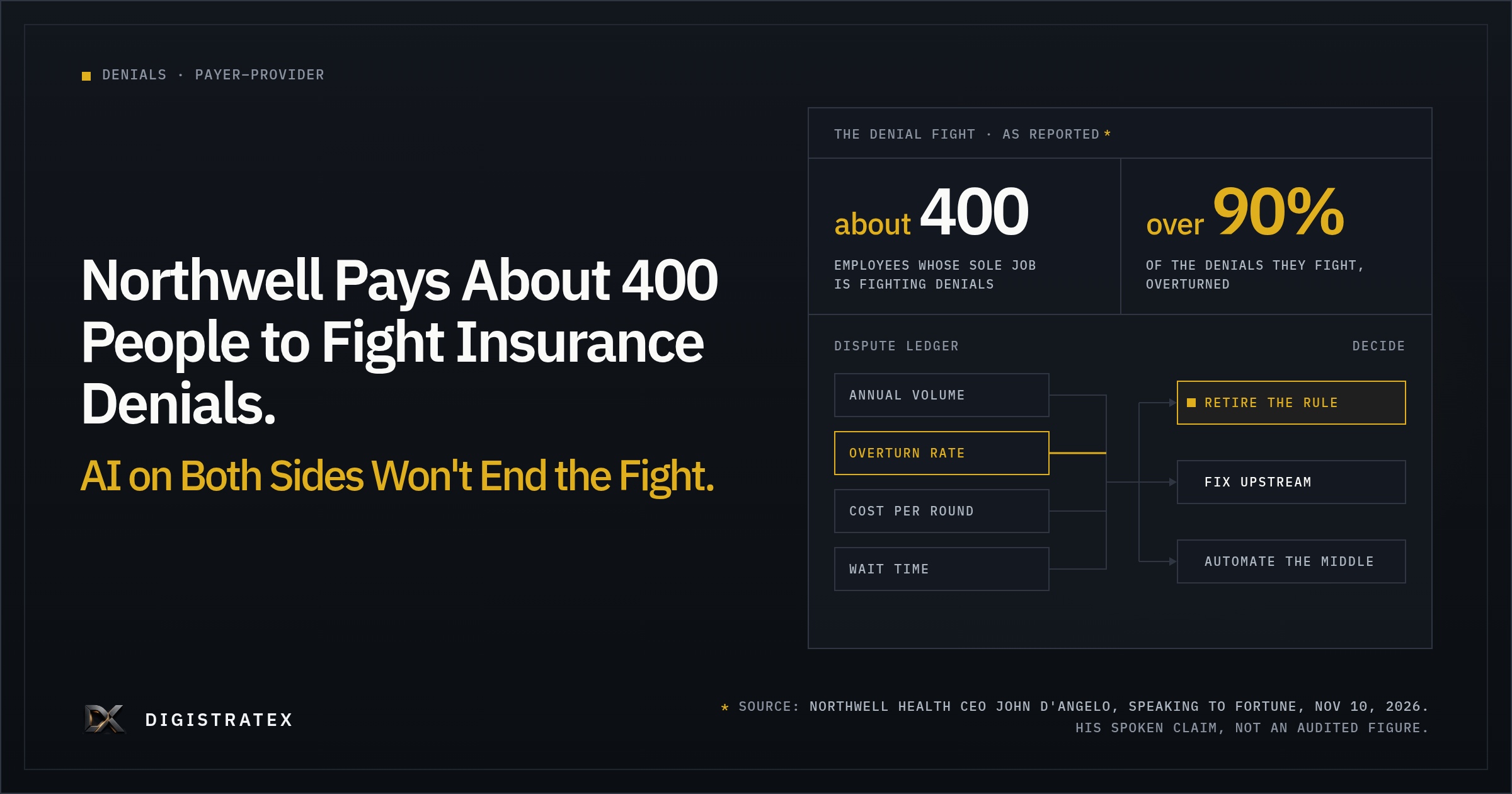
In the same story, Northwell CEO John D'Angelo described his side of that table: "I have like 400 employees whose sole job is fighting the insurance denials, and we overturn over 90% of them, but that's a big labor cost."
Read that sentence twice. New York's largest health system employs a department to win an argument it almost always wins. And the newest answer from the technology industry is to give both sides of that argument faster tools.
That will make each round cheaper. It will not end the fight. For any leadership team, the more useful question is which fights should exist at all.
What a 90% win rate is telling you
Start with what D'Angelo's number does and does not say. It is his spoken figure, not an audited one, and it covers the denials Northwell chooses to contest. A hospital fights the denials it expects to win, so the overturn rate on contested cases will run higher than the error rate on all denials.
Federal data points the same way, though it measures something different. In KFF's analysis of what Medicare Advantage insurers reported to CMS, 80.7% of appealed prior-authorization denials in 2024 were fully or partly overturned, and more than eight in ten have been every year since 2019. The more telling number is the other one: only 11.5% of denials were appealed at all. KFF notes that a reversal can mean the first decision was wrong or that the request was missing documentation. Either way, most denials are never tested.
Even with that caveat, the signal is loud. When a decision is reversed nine times out of ten once someone pushes back, the first decision is not doing its job. It is functioning as a toll. The insurer spends money making it, the hospital spends money undoing it, and the patient waits while both sides do their paperwork.
D'Angelo also told Fortune that Northwell runs on "a 1% margin business at best." At that margin, a department of roughly 400 people devoted to reversing other people's decisions is not a rounding error. It is a strategic cost, and it has a mirror image inside every insurer that issues the denials and reviews the appeals.
Why automating both sides usually means more fighting
Google's pitch is reasonable on its face. Aashima Gupta, its global director of healthcare strategy, told Fortune that "humans are acting as an integration layer today." Software that pulls the chart, checks the coverage rule and drafts the appeal is better than a nurse retyping it.
The trouble is the economics of a dispute. My analysis, not a sourced figure: when each round gets cheaper for both parties, both parties tend to run more rounds. A hospital whose appeal now costs a fraction of what it did will contest denials it used to write off. An insurer whose review now costs less has less reason to tighten the rules that generate denials in the first place. Volume rises to meet the new, lower cost.
You end up with a faster argument, more of it, and the same patient waiting in the middle. The vendor, selling to both sides, is paid either way.
This is not a criticism of Google. It is what happens whenever an organization automates a process before deciding whether the process should exist.
The other path showed up the same week
The same week as Google's launch, Humana, Evolent and American Oncology Network announced a cancer care model, initially rolled out at AON clinics in eight states. AON practices that demonstrate adherence to established quality and evidence-based standards will no longer submit traditional prior authorization requests for most anticancer drug therapies.
That is a different move entirely. It does not make the request faster. It removes the traditional request for providers who have shown they do not need it, and it puts the effort into Evolent's oncology clinical pathways, quality-improvement programs and provider performance scorecards.
Highmark sits in an instructive middle position. It owns both an insurer and a hospital system. Highmark says 78% of approved outpatient prior authorizations submitted digitally now go through automatically, and its president, Karen Hanlon, told Fortune a clinician reviews every case before a denial. That is automation pointed at approving the routine, not at winning arguments.
Every industry has a Northwell department
Strip away the healthcare vocabulary and this pattern is everywhere. Accounts payable teams dispute supplier invoices. Retailers fight card chargebacks. Manufacturers adjudicate warranty claims. Cities process permit appeals. Each of these has its own version of the 400 people, and each now has a vendor offering AI to make the fight faster.
Before buying it, run a dispute ledger. For every recurring dispute type, put four numbers on one page:
| Measure | What it tells you |
|---|---|
| Annual volume | How big the fight is |
| Overturn rate on contested cases | Whether the original decision holds up |
| Fully loaded cost per round, both sides | What the argument costs the system, not just you |
| Time the customer, patient or supplier waits | Who pays while you argue |
Then sort each dispute into one of three decisions.
Retire or waive the rule when the original decision is overturned most of the time. Replace it with a performance standard, as Humana has for qualifying oncology practices. Then audit after the fact to confirm the standard holds.
Fix the submission upstream when the original decision usually holds. The dispute is telling you the other party lacks information or incentives, and that is a design problem at the front end.
Automate the exchange only for what remains in the middle, where the decision is genuinely close and both sides benefit from a faster, better-documented answer. This is where tools like Gemini earn their keep.
Most organizations skip straight to the third box because that is the one a vendor can sell them.
The question for the board
D'Angelo called automating the denial fights "part of driving the affordability conversation the right way." He is right that the labor is a cost worth attacking. But the cheapest dispute is the one that never needs to be filed.
So here is the question I would put to any leadership team this week, in healthcare or anywhere else: which recurring dispute in your business do you win almost every time, and why are you still paying people to fight it?